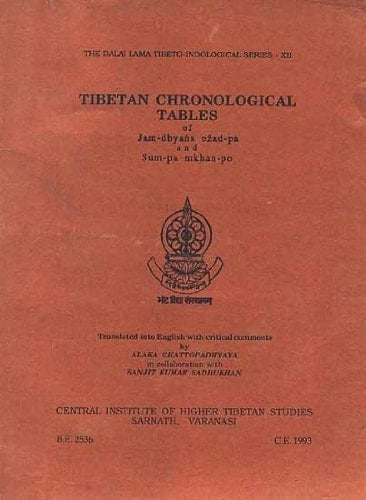
Tibetan chronological tables of ʼJam-dbyaṅs-bźad-pa and Sum-pa Mkhan-po (The Dalai Lama Tibeto-Indological series)
0
0
Author Description
Pages: 296 PUBLISHER'S NOTE History has an important place in human life and its study in the sphere of interaction of cognitive interest is imperative. The investigation of historical events is scientifically augmented on the basis of a time frame called the "chronology" which forms the subject matter of the present study. The system of sexagenary cycle was adopted in India and China and Asian-duodenary animal system was adopted in East and Central Asia. Tibetan scholars came to adopt the system of sexagenary cycle so called "Rab-byung" in the 11th century commencing from 1027 A.D. This system has proved very conducive in enumerating events of each year with precision. The system became popular and two Tibetan chronological tables were compiled; one by 'Jam-dbyangs bZad-pa and the other much later by Sum-pa mkhan-po. The tables cover the first twelve cycles out of the seventeen cycles including the current one. Dr (Mrs) Alaka Chattopadhyaya realizing the importance and need of an English translation of 'Jam-dbyans bzad-pa's chronological work; despite Sum-pa mkhan-po's already translated work into English by sh. S. C. Das, undertook the present translation in collaboration with Sh. Sanjit Kumar Sadhukhan. The translation is mainly based on 'Jam-dbyans bzad-pa's work whereas Sum-pa's deviations-major or minor, are included in it which provide additional information. I am glad that this translation is being published under the Dalai Lama Tibeto-Indological Series of the Institute's publications. I hope that the work will benefit a great number of scholars and researchers of Tibetan and Buddhist studies. Acknowledgements I must first express my gratitude to the Indian Council of Historical Research, New Delhi. By granting a research fellowship it enabled me to be
Page Count:
296
Publication Date:
1993-01-01
ISBN-10:
8190014951
ISBN-13:
9788190014953