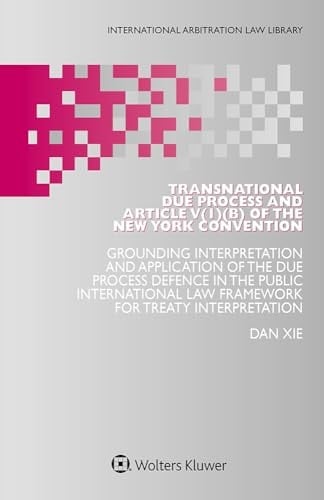
Transnational Due Process and Article V(1)(b) of the New York Convention Grounding Interpretation and Application of the Due Process Defence in the Public International Law Framework for Treaty Interpretation
0
0
Author Description
Widely regarded as the most important ground for refusal under the 1958 United Nations Convention on the Recognition and Enforcement of Foreign Arbitral Awards (New York Convention), Article V(1)(b), commonly referred to as the 'due process' clause, is interpreted in diverse ways across jurisdictions. This book not only thoroughly examines the variety of approaches to the clause adopted by different national courts but also presents a particular understanding of the transnational approach to the due process defence grounded in the interpretative framework of the Vienna Convention on the Law of Treaties. Drawing on insights and methods from comparative law that consider not only national legal systems but also international commercial arbitration and other international legal regimes, the author specifically leverages the principle of audiatur et altera pars and subsequent state practice. Among the matters examined are the following: threshold requirements for the due process defence; policy considerations of and relevant limits to the interpretation and application of the due process defence; proper notice of the appointment of the arbitrator or of the arbitration proceedings; opportunity to present a case and equal treatment; and the lex arbitri, lex fori, and uniform transnational approaches to the applicable law for the due process defence. The book includes a detailed comparative analysis of numerous domestic judicial decisions across jurisdictions. A comprehensive bibliography includes references to cases, awards, treaties, UN Documents, legislation, institutional rules, and soft laws. The book shows clearly how an understanding of transnational due process grounded in the interpretative framework mandated by international law can contribute to the uniform interpretation and application of Article V(1)(b), thus contributing to debates
Page Count:
246
Publication Date:
2024-01-01
ISBN-10:
9403524375
ISBN-13:
9789403524375