Author Description
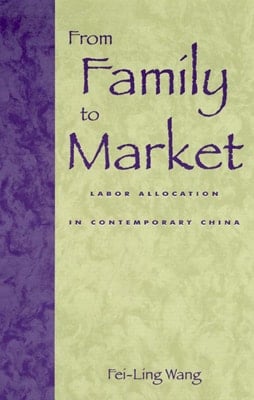
Review Wang describes patterns of labour in great detail...the descriptions of community -based labour allocation are interesting.. A focus of attention on labour alloction patterns may be useful in understanding China's political and economic institutions. (Yanjie Bian The China Journal, January 2000)Wang describes patterns of labour in great detail...the descriptions of community -based labour allocation are interesting.. A focus of attention on labour alloction patterns may be useful in understanding China's political and economic institutions. (Yanjie Bian The China Journal, January 2000) Product Description This book analyzes Chinese history, politics, and economic development through the lens of labor allocation within the world's largest workforce. Capturing the peculiarities, continuities, and changes in the PRC's institutional structure, Fei-Ling Wang examines the segmented nature of China's labor force today. He points to the rare coexistence of four 'labor allocation patterns:' the traditional family-based system, authoritarian state allocation, community-based labor markets, and the emerging national labor market. China's enduringly stable yet backward institutional structure was based firmly on a mix of family and state institutions; now the addition of market forces highlights the PRC's transitional state. Bolstered with rich case-study detail and Chinese source material, this study argues that the development of labor allocation patterns will profoundly influence China's political and economic development in the coming century. About the Author Fei-Ling Wang is assistant professor at the Sam Nunn School of International Affairs, Georgia Institute of Technology.
Page Count:
368
Publication Date:
1998-03-01
ISBN-10:
0847688798
ISBN-13:
9780847688791