Author Description
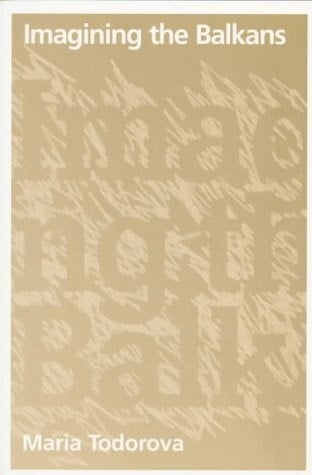
Product Description"If the Balkans hadn't existed, they would have been invented" was the verdict of Count Hermann Keyserling in his famous 1928 publication Europe. In Imagining the Balkans, Maria Todorova attempts to trace the relationship between the reality and the invention. Based on a rich selection oftravelogues, diplomatic accounts, academic surveys, journalism, and belles lettres in many languages, this work explores the ontology of the Balkans--their Ottoman legacy, as well as questions of ascription and self-presentation. It also studies the ways in which a particular intellectual traditionwas constructed, became mythologized, and is being transmitted as discourse.Starting in the eighteenth century and continuing up to the present, Imagining the Balkans covers the Balkans' most formative years. From the downfall of the Ottoman Empire, through the turbulent nationalist years of the nineteenth century, up to World War I, the idea of the Balkans was fiercely,often violently, contested. In the wake of World War I emerged the beginnings of a tradition, largely enforced by academics, stigmatizing the Balkans. Since then, the region has suffered from the neglect, abuse, and scant regard of both Western Europe and the world. The result has been in manydirect ways to compound the Balkans' poverty, internal violence, and lack of positive national self-images.Todorova's thesis is more than a mere "orientalist variation" on a Balkan theme. She treats Balkanism not as a simple sub-species of Orientalism, but as an independent category with its own specific links to the dominant European discourse. By being geographically inextricable from Europe, yetculturally constructed as "the other," the Balkans have served as a repository of negative characteristics against which a positive and self-congratulatory image of the "European" has been constructed.Raised in the Balkans, Maria Todorova is in a unique position to bring both scholarship and sympathy to her subject. She offers a timely, accessible study of when, why, and by what means an innocent geographical appellation was transformed into one of the most powerful and extensively used andabused pejorative designations in modern history.About the AuthorAbout the AuthorMaria Todorova earned a degree in history from the University of Sofia in Bulgaria, where she taught Balkan history until 1988. She has since taught at several American universities, and is currently Professor of Balkan and East European History at the University of Florida.
Page Count:
272
Publication Date:
1997-01-01
ISBN-10:
019508750X
ISBN-13:
9780195087505
Community Tags
Reader Comments
Share Your Thoughts
No comments yet. Be the first to share your thoughts!