Author Description
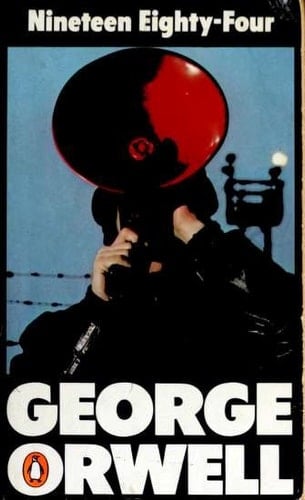
One of Britain's most popular novels, George Orwell's dystopian tale Nineteen Eighty-Four is set in a society terrorised by a totalitarian ideology propagated by The Party. 'It was a bright cold day in April, and the clocks were striking thirteen.' Winston Smith works for the Ministry of Truth in London, chief city of Airstrip One. Big Brother stares out from every poster, the Thought Police uncover every act of betrayal. When Winston finds love with Julia, he discovers that life does not have to be dull and deadening, and awakens to new possibilities. Despite the police helicopters that hover and circle overhead, Winston and Julia begin to question the Party; they are drawn towards conspiracy. Yet Big Brother will not tolerate dissent - even in the mind. For those with original thoughts they invented Room 101... Nineteen Eighty-Four is George Orwell's terrifying vision of a totalitarian future in which everything and everyone is slave to a tyrannical regime. The novel also coined many new words and phrases which regular appear in popular culture, such as 'Big Brother', 'thoughtcrime', 'doublethink' and 'Newspeak'. 'More relevant to today that almost any other book that you can think of' Jo Brand 'Right up there among my favourite books...I read it again and again' Margaret Atwood George Orwell (Eric Arthur Blair) was an accomplished social, political and literary commentator and essayist known for his non-fiction works The Road to Wigan Pier and Homage to Catalonia. His most famous novels, Animal Farm and 1984 have influenced a generation of twentieth century political satirists and dystopian novelists. This edition of Orwell's seminal novel is introduced by Professor Peter Davidson.
Menrva's Summary
THE PULSE
Winston Smith attempts to maintain his individuality and sanity within a pervasive totalitarian regime that demands absolute conformity. Living in the decaying city of London, Winston works for the Ministry of Truth, where he systematically alters historical records to align with the shifting propaganda of the state. He faces the constant surveillance of the Thought Police and the omnipresent gaze of Big Brother, which restrict his physical movements and internal thoughts. The narrative follows his clandestine rebellion and his pursuit of a forbidden romantic connection with a woman named Julia. The story is presented through a third-person limited perspective that focuses on Winston's internal struggle against the logical constraints of a society designed to eliminate objective truth.
INSIDE THE PAGES
- Exploration of linguistic control through the development of Newspeak
- Examination of psychological manipulation via doublethink
- Detailed depiction of state-sponsored surveillance and the panopticon effect
- Analysis of the erasure and revision of historical records
- Use of Room 101 as a manifestation of ultimate psychological terror
- Focus on the erosion of personal privacy and intimate relationships
- Integration of political satire regarding authoritarian power structures
- Third-person limited narrative framework centered on the protagonist's internal monologue
THE COLLECTIVE ECHO
Discussion often centers on the novel's enduring relevance regarding state surveillance and the manipulation of truth in modern political discourse. Readers frequently highlight the clinical, oppressive atmosphere that Orwell constructs to mirror the bleakness of the protagonist's existence. Critics often examine the effectiveness of the world-building, particularly how the Party uses language to limit the range of human thought. The balance between the slow-burn psychological tension and the inevitable, grim conclusion remains a primary focus for those analyzing the work's impact on the dystopian genre. Many readers note that the book serves as a foundational text for understanding the mechanics of totalitarian control.
Page Count:
256
Publication Date:
1954-01-05
ISBN-10:
0140009728
ISBN-13:
9780140009729
Fantasy
Science
Fiction
Classics
Science Fiction
Dystopian
Dystopian
classic
Fiction
Fiction political
London England
Classics
Contemporary
New Used & Rental Textbooks
Literary
Fiction dystopian
Social Commentary
Political fiction
Science Fiction