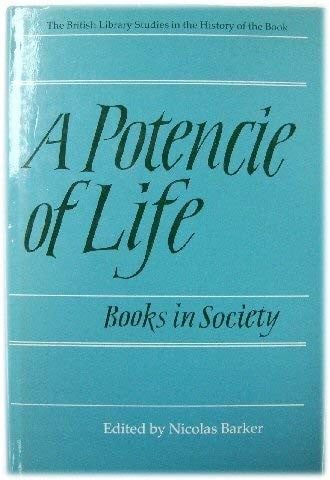
A Potencie of Life: Books in Society: The Clark Lectures 1986-1987 (British Library Studies in the History of the Book)
0
0
Author Description
'Books are not absolutely dead things but doe contain a potencie of life in them to be as active as the soule whose progeny they are; nay they do preserve as in a violl the purest efficacie and extraction of that living intellect that bred them.'. The words are John Milton's, and enshrine his concept that a written text has a life independent of its author, and that words, when preserved in the form of a book, have a particular power to move and influence. Texts give nourishment to the press, which in turn feeds the reading public. All depend on the book as an animate object. It is this process of interdependent exchange that is the central theme of these essays, based on lectures given at the William Andrews Clark Library in 1986-7. The contributors shed fascinating light on many aspects of the history of the book. The exceptionally wide range of topics relates to the manuscript as well as the printed book, to papermaking in America, to hand bookbinding, and to authorship and maritime publishing in 18th-century Britain. Of special interest to the business historian are the discussions of the financing of these operations. In a particularly important introductory essay, Thomas R. Adams and Nicolas Barker discuss the influential 'communication circuit' published in 1982 by Robert Darnton, which relates the many roles played in the creation and distribution of books from author to reader. They put forward 'a new model for the study of the book' which maps intellectual, social, political, legal, religious and commercial influences and pressures in relation to the key functions that collectively comprise publication. The essay serves as a manifesto, the aim of which is to draw historians and bibliographers closer to a common purpose.
Page Count:
216
Publication Date:
1995-07-01
ISBN-10:
0712302875
ISBN-13:
9780712302876