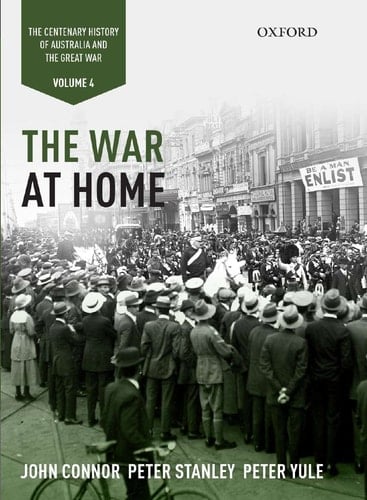
The War at Home: Volume IV: The Centenary History of Australia and the Great War
0
0
Author Description
Product Description The War at Home interprets the experience of the Australian people during the Great War in Australia itself, in the politics of war, its economic and social effects, and in the experience of war; what is conventionally called social history. It seeks to show that the war affected many aspectsof Australians lives and that peoples' experience of 1914-18 included more than just the war. It also addresses the impact of the war on Australia's culture and artistic responses to the war.This volume draws on the uneven but still substantial body of scholarship that has grown up in the decades since Ernest Scotts official history appeared in 1936, which in turn has largely been founded on an array of sources mainly made available since then. The Bibliographic Essay discusses thesecondary literature on which it is based. It also reflects the experience of the years since then. The events of our past change how we understand more distant history. It is impossible now to think of the internment of German Australians without also reflecting on the experiences of those detainedin immigration detention camps, to think of the battle of Broken Hill without also thinking of the war on terror pursued from 2001, or to look at Norman Lindsay's posters without recalling the insidious influence of propaganda in the century since. Before understanding the way the Great War affected Australians, we need to acknowledge the texture of life in 1914. Australia before the Great War was, as Michelle Hetherington writes in a survey of the last full year of peace, a world of glorious possibilities, in which as a social laboratory ofprogressive social, industrial and economic legislation it was eager to learn, to develop, to dream. The war would damage that dream, arguably fatally. About the Author John Connor is a Senior Lecturer in History at UNSW Canberra. He is the author or editor of several books on the First World War and Australian Military History.Peter Stanley is one of Australia's most active military-social historians. He has published 25 books, mainly in the field of Australian military history, but also in medical history, British India, British military history and bushfires. He is currently a Research Professor in the Australian Centrefor the Study of Armed Conflict and Society at the University of New South Wales, Canberra.Peter Yule is a Research Fellow of the School of Historical and Philosophical Studies at the University of Melbourne. He has written widely on Australian economic, business and military history, with his books including biographies of Sir Ian Potter and W.L. Baillieu, and histories of the CollinsClass submarine project and Australian National Airways.Professor Jeffrey Grey is a leading military historian with an interest in contemporary warfare. He teaches Australian Military History, Contemporary Warfare and US Military History. He is a member the Army Historical Advisory Committee and the Army History Research Grant Schemes Committee, aConsultant to the Department of Veterans Affairs Series, a consultant to the 8-part television series Australians at War (2001), and adjunct senior research fellow, Land Warfare Studies Centre. Professor Grey is series editor of Centenary History of Australia and the Great War.
Page Count:
320
Publication Date:
2016-01-01
ISBN-10:
0195576780
ISBN-13:
9780195576788
Australia
Community Tags
Reader Comments
Share Your Thoughts
No comments yet. Be the first to share your thoughts!