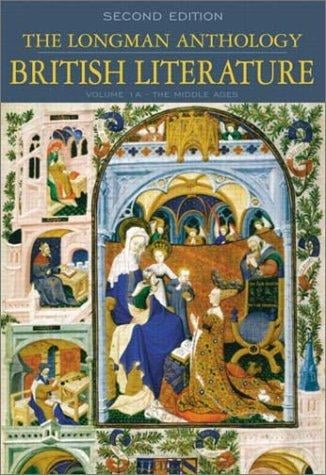
The Longman Anthology of British Literature: Volume 1A, The Middle Ages
0
0
Author Description
At the present time, there are five languages in Britain, just as the divine law is written in five books, all devoted to seeking out and setting forth one and the same kind of wisdom, namely the knowledge of sublime truth and of true sublimity. These are the English, British, Irish, Pictish, as well as the Latin languages; through the study of the scriptures, Latin is in general use among them all. Bede, Ecclesiastical History of the English People The Venerable Bede’s famous and enormously influential Ecclesiastical History of the English People, written in the early 700s, reflects a double triumph. First, its very title acknowledges the dominance by Bede’s day of the Anglo-Saxons, who, centuries earlier, had established themselves on an island already inhabited by Celtic Britons and by Picts. Second, the Latin of Bede’s text and his own life as a monk point to the presence of ancient Mediterranean influences in the British Isles, earlier through Rome’s military colonization of ancient Britain and later through the conversion of Bede’s people to Roman Christianity. In this first chapter of his first book, Bede shows a complex awareness of the several populations still active in Britain and often resisting or encroaching on Anglo-Saxon rule, and much of his History narrates the successive waves of invaders and missionaries who had brought their languages, governments, cultures, and beliefs to his island. This initial emphasis on peoples and languages should not be taken as early medieval multiculturalism, however: Bede’s brief comparison to the single truth embodied in the five books of divine law also shows us his eagerness to draw his fragmented world into a coherent and transcendent system of Latin-based Christianity. It is useful today, however, to think about medieval Britain, before and long after Bede, as a multilingual and multicultural setting, densely layered with influences and communities that divide, in quite different ways, along lines of geography, language, and ethnicity, as well as religion, gender, and class. These elements produced extraordinary cultures and artistic works, whose richness and diversity challenge the modern imagination. The medieval British Isles were a meeting place, but also a point of resistance, for wave after wave of cultural and political influences. Awareness of these multiple origins, moreover, persisted. In the mid-thirteenth century, Matthew Paris’s map of England (Color Plate 4) reflects an alertness to the complex geography of history and settlement on his island. Six hundred years after Bede we encounter a historian like Sir Thomas Gray complaining that recent disorders were “characteristic of a medley of different races. Wherefore some people are of the opinion that the diversity of spirit among the English is the cause of their revolutions” (Scalacronica, c. 1363).
Page Count:
704
Publication Date:
2002-08-16
ISBN-10:
0321106679
ISBN-13:
9780321106674
Community Tags
Reader Comments
Share Your Thoughts
No comments yet. Be the first to share your thoughts!