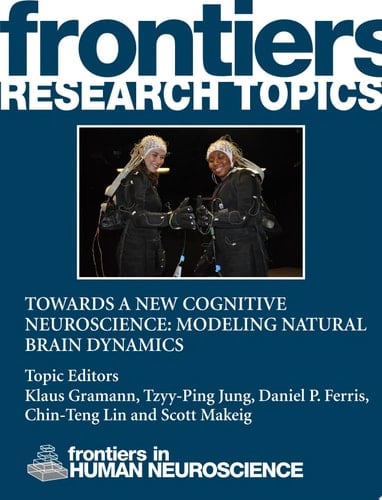
Towards a New Cognitive Neuroscience: Modeling Natural Brain Dynamics
0
0
Author Description
Decades of brain imaging experiments have revealed important insights into the architecture of the human brain and the detailed anatomic basis for the neural dynamics supporting human cognition. However, technical restrictions of traditional brain imaging approaches including functional magnetic resonance tomography (fMRI), positron emission tomography (PET), and magnetoencephalography (MEG) severely limit participants’ movements during experiments. As a consequence, our knowledge of the neural basis of human cognition is rooted in a dissociation of human cognition from what is arguably its foremost, and certainly its evolutionarily most determinant function, organizing our behavior so as to optimize its consequences in our complex, multi-scale, and ever-changing environment. The concept of natural cognition, therefore, should not be separated from our fundamental experience and role as embodied agents acting in a complex, partly unpredictable world. To gain new insights into the brain dynamics supporting natural cognition, we must overcome restrictions of traditional brain imaging technology. First, the sensors used must be lightweight and mobile to allow monitoring of brain activity during free participant movements. New hardware technology for electroencephalography (EEG) and near infrared spectroscopy (NIRS) allows recording electrical and hemodynamic brain activity while participants are freely moving. New data-driven analysis approaches must allow separation of signals arriving at the sensors from the brain and from non-brain sources (neck muscles, eyes, heart, the electrical environment, etc.). Independent component analysis (ICA) and related blind source separation methods allow separation of brain activity from non-brain activity from data recorded during experimental paradigms that stimulate natural cognition. Imaging the precisely timed, distributed brain dynamics that support all forms of our motivated actions and interactions in both laborato
Page Count:
166
Publication Date:
2014-10-03
ISBN-10:
2889192717
ISBN-13:
9782889192717
Community Tags
Reader Comments
Share Your Thoughts
No comments yet. Be the first to share your thoughts!