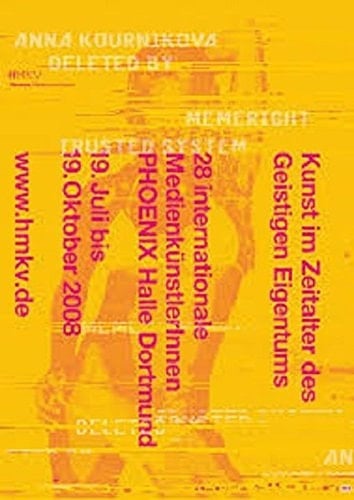
Anna Kournikova deleted by memeright trusted system
0
0
Author Description
How does the changing notion of (creative) work relate to 'intellectual property'? Today we live in a post-industrial society where the goods being produced are no longer material (like steel, coal, etc.), but immaterial. The Ruhr Area, with its vast deindustrialised landscape, paradigmatically stands for this transition from the Industrial Age to the information or knowledge society. However, opposite to material goods, immaterial goods such as knowledge and information can be reproduced without loss. Therefore, in order to function in a value-added chain, the distribution of these immaterial goods has to be restricted. This is effectuated with the aid of intellectual property (IP) law, namely copyright, patent, and trademark law. David Rice's perfidious short story 'Anna Kournikova Deleted By Memeright Trusted System' - from which curators Inke Arns and Francis Hunger have borrowed the exhibition title - deals with the concept of intellectual property: In 2067 stars - such as ex-tennis player Anna Kournikova - have their 'brand' protected by a satellite-based system that identifies unlicensed look-alikes and eliminates them via a strong laser beam. During a trip to the Pacific Rim, not officially cleared, the 'real' Anna Kournikova is identified as an imitation of herself and is consequently eliminated by the system. The 28 artists represented in this exhibition explore the question of art in the age of mechanical reproduction positioning itself differently in a post-Fordist era permeated with digital networks than in Fordist, analogue times to which Walter Benjamin has referred. Artistic techniques like cut-up, sampling, détournement, appropriation, copying, remixing, plagiarism, and repetition are employed"--Publisher's website.
Page Count:
224
Publication Date:
2008-01-01
ISBN-10:
3941100262
ISBN-13:
9783941100268