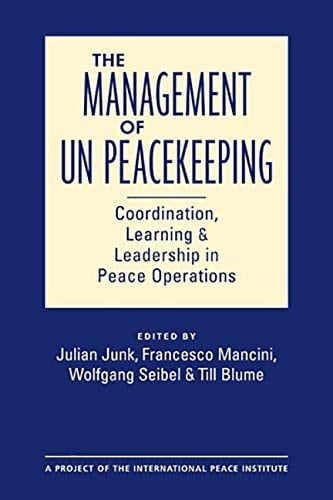
The Management of UN Peacekeeping Coordination, Learning, and Leadership in Peace Operations
0
0
Author Description
This groundbreaking book brings the insights of organization and public administration theories to the analysis and enhancement of complex peace operations. Focusing on three essential and interrelated aspects of organizations--coordination, learning, and leadership--the authors bridge the gap between research on UN peacekeeping and the realities confronted both in the office and in the field. CONTENTS: Foreword--Terje Rød-Larsen. The Management of UN Peacekeeping--J. Junk and F. Mancini. Coordination, Learning, and Leadership: Challenges of Peace Operations--W. Seibel, J. Junk, T. Blume, and E. Schöndorf. COORDINATION. Coordination and Networks--A. Herrhausen. Network and Transaction Cost Theories: Lessons from Bosnia-Herzegovina--M. Lipson. Peace Operations as Temporary Network Organizations--J. Raab and J. Soeters. Integrated DDR: Lessons for Coordination in Peace Operations?--T. Pietz. The Elusive Coherence of Building Peace--C. de Coning. The Coherence Conundrum in Peace Operations--A. Bhattacharjee. LEARNING. Organizational Learning and Peace Operations--A.B. Antal, J. Junk, and P. Schumann. Learning and Identity in the Field--M. Mai, R. Klimecki, and S. Döring. Bureaucracy and Learning at Headquarters--T. Benner, S. Mergenthaler, and P. Rotmann. Organizational Change in International Bureaucracies--M. Bauer, H. Jörgens, and C. Knill. LEADERSHIP. Leadership in Organizations: A Review--S. Börner. Leadership the United Nations: A Secretary or a General?--S. Chesterman and T.M. Franck. Leading Peace Operations: The Special Representatives of the UN Secretary-General--M. Fröhlich. Role Models of Leadership in Peace Operations: Lessons from Kosovo--F. Trettin. CONCLUSION. Linking Coordination, Learning, and Leadership--F. Mancini and J. Junk.
Page Count:
433
Publication Date:
2017-01-01
ISBN-10:
1626375852
ISBN-13:
9781626375857