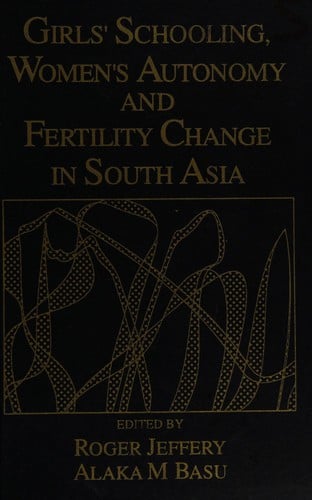
Girls' schooling, women's autonomy, and fertility change in South Asia
0
0
Author Description
Of all the links between social factors and demographic change in the developing world, the relationship between female schooling and fertility decline has long been argued to be one of the most powerful. However, there is as yet little agreement on how the correlations should be understood and explained, and what impact this should have on public policy. This major volume challenges the popular notions that there is a universal and causal relationship between rising levels of schooling and declining levels of fertility, and that schooling enhances female autonomy. The volume concludes that schooling is indeed important for women and should definitely be supported and encouraged, but not because of the possible impact it may have on fertility decline. Further, that while resources should continue to be devoted to the spread of education, this should not be at the expense of providing women-friendly contraceptive and maternal/child health services, which give couples the ability to successfully plan the size of the family they want. Challenging as it does the orthodoxy that sending girls to school is equivalent to 'educating' them and that educating the girl child is both necessary and sufficient for fertility decline to follow in South Asia, this book will be essential reading for demographers, planners, funding bodies and social anthropologists and will also be of considerable interest to students of gender studies and South Asian affairs.
Page Count:
339
Publication Date:
1996-01-01
ISBN-10:
0803992769