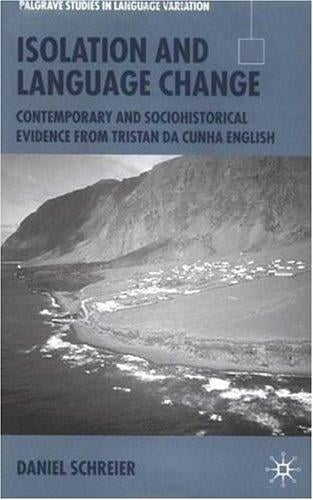
Isolation and language change: contemporary and sociohistorical evidence from Tristan da Cunha English
0
0
Author Description
"Extremely isolated communities offer 'laboratory conditions' for examining the processes of language change and dialect formation. This book presents findings of the first ever ethnographic fieldwork on the most remote island in the world with a permanent population, Tristan da Cunha. It documents the historical formation of a unique local dialect and investigates the sociolinguistic mechanisms that underlie dialect contact and new-dialect formation. Based on the settlement history of the local community, the book offers an in-depth analysis of the social and linguistic motivation of feature selection and retention, analysing the outcomes of mutual interaction, long-term accommodation and language hybridisation in this setting. Linguistic processes are illustrated with several case-studies of individual features, including, mixing, levelling, categoricality, and the development of unique language structures, highlighting the importance of geographic isolation for their stabilisation and evolution. Special emphasis is given to the linguistic consequences of post-insularity - language-change processes as a result of increasing contacts with other communities and speakers. Researchers and students of language variation and change, as well as anthropologists and ethnographers, will find this study as unique resource."--BOOK JACKET.
Page Count:
237
Publication Date:
2003-01-01
ISBN-10:
1403904073