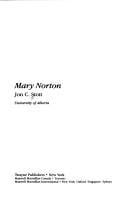
Author Description
Mary Norton's gift for making the imaginary credible and for then using the imaginary to address deep-felt concerns about the human condition renders her one of the preeminent children's writers of the twentieth century. Such universal themes as the permanence of memory, the value of stories and storytelling, the significance of children's relationships to adults, the quest for identity in an uncertain world, and the passage from childhood to maturity all find their way into her eight novels for children through a host of disarmingly fanciful characters. In The Magic Bed-Knob (1943) and Bonfires and Broomsticks (1947) - the sources of the 1971 motion picture Bedknobs and Broomsticks - a timid apprentice witch provides adventure and imaginative release for two British children waiting out World War II in the United States. In Norton's acclaimed novel The Borrowers and its four sequels (1952-1982) a band of six-inch tall beings lead a precarious yet determinedly dignified existence in cast-off boots and kettles and under the floorboards of country homes, subsisting on the flotsam and jetsam of the human beings towering above them. Homelessness is a constant threat; detection by their human hosts calls for immediate departure and a search for new quarters. In Are All the Giants Dead? (1975) a boy enters the realm of aging fairy-tale figures after the conclusion of their great adventures, where life is not quite the happily-ever-after that fairy tales promise. Jon C. Stott's Mary Norton is the first book-length study of her entire work. In it he assesses her novels' persistent themes, character types, and situations, draws parallels between the novels and Norton's life experience - especially her idyllic childhood in Bedfordshire, England, and her dislocation to the United States during World War II - and examines the novels in light of twentieth-century British literature and contemporary critical theory, particularly feminist criticism, narratology, and reader response theory. Norton, Stott writes, is particularly attentive to the emotional development of girls into womanhood and is, for a children's writer, unusually conscious of the interactive relationship between storyteller and listener. She shares with writers such as William Faulkner and Isobel Allende a view of the listener/reader not as passive recipient but as re-creator and cocreator. She frequently employs the device of the frame story, with one character serving as the teller of the novel's story and another as its listener. The teller, an adult, thus preserves a cherished memory, and the listener, a child, is transformed in receiving it. Throughout Stott manages a sophisticated critique of Norton's work that never negates its whimsy, wit, and charm for young readers. Mary Norton's literary concerns were ultimately what she perceived to be children's concerns, "concerns that," as Stott writes, "may well be timeless."
Page Count:
158
Publication Date:
1994-01-01
ISBN-10:
0805770542
Community Tags
Reader Comments
Share Your Thoughts
No comments yet. Be the first to share your thoughts!