Author Description
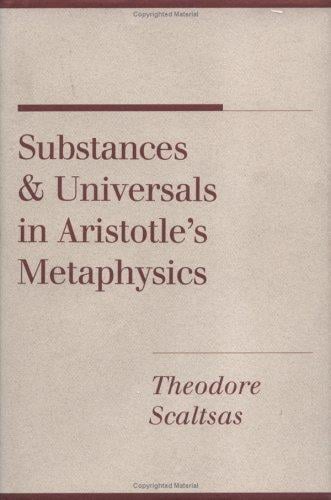
Theodore Scaltsas here brings the insights of contemporary philosophy to bear on a classic problem in metaphysics that stems from Aristotle's theory of substance. Scaltsas provides an analysis of the enigmatic notions of potentiality and actuality, which he uses to explain Aristotle's substantial holism by showing how the concrete and the abstract parts of a substance form a dynamic, diachronic whole. Aristotle responds in his metaphysics to a problem with Platonic theory: when a property belongs to a subject, is the property a feature of the subject or does it determine the nature of the subject? Furthermore, can the nature of a subject "belong to" the subject? Scaltsas approaches this problem of the relation of the essence to the substance and its constituents from the perspective of the part-whole relation. This topic is becoming a central concern of current metaphysics and has much to offer to our understanding of the unity of a substance. In an ingenious formulation of Aristotle's solution to the Platonic problem, Scaltsas argues that for Aristotle the essence-in-actuality is not a constituent that belongs to the subject but is the subject. Scaltsas reconstructs, from the difficult and contested central books of the Metaphysics, how Aristotle resolves the metaphysical problems that stem from his distinction between essence-in-abstraction and essence-in-actuality. Scaltsas further offers an account of the unity that essence-in-actuality comprehends between particular substantial constituents and universals.
Page Count:
292
Publication Date:
1994-01-01
ISBN-10:
0801430038