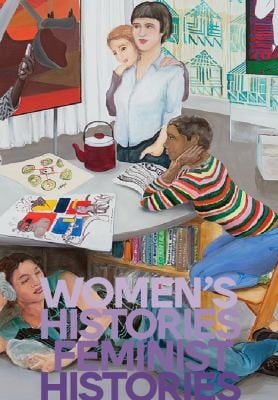
The exhibition "Women<U+2019>s Histories" presents nearly a hundred works dating from the 1st to the 19th centuries. As the title indicates, this is not a single history, but rather many, chronicled through objects made by women who lived in Northern Africa, the Americas (before and after colonization), Asia, Europe, India and the ancient Ottoman Empire...t is difficult to point to feminist histories before the 19th century, and for this reason we say women<U+2019>s histories. But looking back at women artists of previous eras helps establish feminist lineages. An encounter with these multiple precursors<U+2014>named and unnamed, famous and obscure<U+2014> invites us to rethink traditional art history and its hierarchies that tend to celebrate art as an activity for white European men. -- MASP website [https://masp.org.br/en/exhibitions/histories-of-women]. This exhibition ["Feminist histories: artists after 2000"] features works by 30 artists and collectives that emerged in the 21st century and which work from feminist perspectives, broadening a debate that gained visibility in the visual arts in the period spanning from the 1960s through the 1980s, and which continues to intersect struggles, narratives and knowledges. To address feminist histories in the 21st century means starting from the present moment, in the midst of its construction and urgency. Addressing them at MASP involves a further factor, insofar as they are being told at a museum located in the Global South, with one of the most important collections of European art in this hemisphere, and located on one of the main avenues of the city of São Paulo, the stage for demonstrations and political, social, economic and symbolic struggle. It is a museum designed by architect Lina Bo Bardi, with a suspended structure sheltering a public plaza at ground level, thus resulting in a museum shot through by the public space, with all its contradictions. Therefore, this exhibition considers the possible relations between the museum and the street, between art and activism. There is no single definition of what constitute the feminist strategies and practices in art, but rather a plural understanding of its various currents, considering the many forms of action and the specificities of their contexts <U+2013> this is why the title is feminist histories, in the plural. The category "woman" is also not understood here as singular and universal, as it is intersected by various social, geographic and temporal markers that transform this experience. However, it is possible to affirm that the feminisms are responses to the material precarity, the physical and psychological violations, to the silencings, and the subalternity experienced by diverse women in the course of patriarchal history and past realities that were very often colonial. -- MASP website [https://masp.org.br/en/exhibitions/feminist-histories].
Page Count:
310
Publication Date:
2019-01-01
Community Tags
Reader Comments
Share Your Thoughts
No comments yet. Be the first to share your thoughts!