Author Description
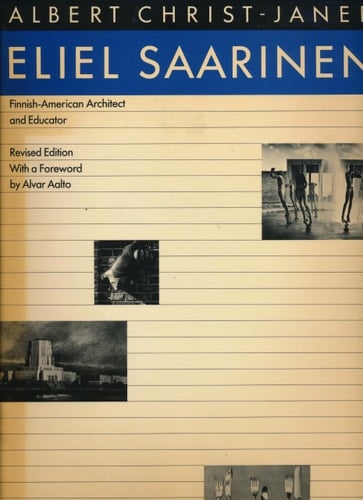
Gottlieb Eliel Saarine was a Finnish architect who became famous for his art nouveau buildings in the early years of the 20th century. He was educated at the Helsinki University of Technology. From 1896 to 1905 he worked as a partner at Gesellius, Lindgren, and Saarinen. His first major work with the firm, the Finnish pavilion at the World Fair of 1900, exhibited an extraordinary convergence of stylistic Finnish wooden architecture, the British Gothic Revival, and the Jugendstil. Saarinen's early manner was later christened the Finnish National Romanticism and culminated in the Helsinki Central railway station.From 1910–15 he worked on the extensive city-planning project of Munksnäs-Haga and later published a book on the subject. In 1911 he became a consultant in city planning for Reval, Estonia and was invited to Budapest to advise in city development. In 1912, a brochure written by Saarinen about the planning problems of Budapest was published. In April 1913 he received the first place award in an international competition for his plan of Reval. During 1917-18 Saarinen worked on the city-plan for greater Helsinki. He also designed the Finnish markka banknotes introduced in 1922.Eliel Saarinen moved to the United States in 1923 after his competition entry for the Tribune Tower in Chicago, Illinois, which won second place and was not built in Chicago. Nonetheless, his design was fully realized in the 1929 Gulf Building in Houston, Texas. Saarinen first settled in Evanston, Illinois, where he worked on his scheme for the development of the Chicago lake front. In 1925 George Gough Booth asked him to design the campus of Cranbrook Educational Community. Saarinen taught there and became president of the Cranbrook Academy of Art in 1932. Among his student-collaborators were Charles and Ray Eames whose subsequent furniture design he influenced.
Page Count:
169
Publication Date:
1984-01-01
ISBN-10:
0226104656
ISBN-13:
9780226104652