Author Description
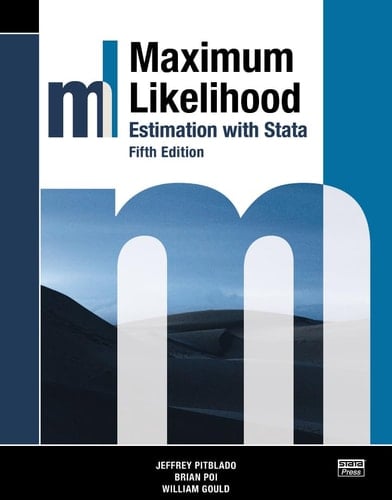
Maximum Likelihood Estimation with Stata, Fifth Edition is the essential reference and guide for researchers in all disciplines who wish to write maximum likelihood (ML) estimators in Stata. Beyond providing comprehensive coverage of Stata's commands for writing ML estimators, the book presents an overview of the underpinnings of maximum likelihood and how to think about ML estimation. The fifth edition includes a new second chapter that demonstrates the easy-to-use mlexp command. This command allows you to directly specify a likelihood function and perform estimation without any programming. The core of the book focuses on Stata's ml command. It shows you how to take full advantage of ml's noteworthy features: Linear constraints Four optimization algorithms (Newton-Raphson, DFP, BFGS, and BHHH) Observed information matrix (OIM) variance estimator Outer product of gradients (OPG) variance estimator Huber/White/sandwich robust variance estimator Cluster-robust variance estimator Complete and automatic support for survey data analysis Direct support of evaluator functions written in Mata When appropriate options are used, many of these features are provided automatically by ml and require no special programming or intervention by the researcher writing the estimator. In later chapters, you will learn how to take advantage of Mata, Stata's matrix programming language. For ease of programming and potential speed improvements, you can write your likelihood-evaluator program in Mata and continue to use ml to control the maximization process. A new chapter in the fifth edition shows how you can use the moptimize() suite of Mata functions if you want to implement your maximum likelihood estimator entirely within Mata. In the final chapter, the authors illustrate the major steps required to get from log-likelihood function to fully operational estimation comman
Page Count:
472
Publication Date:
2023-01-01
ISBN-10:
159718411X
ISBN-13:
9781597184113