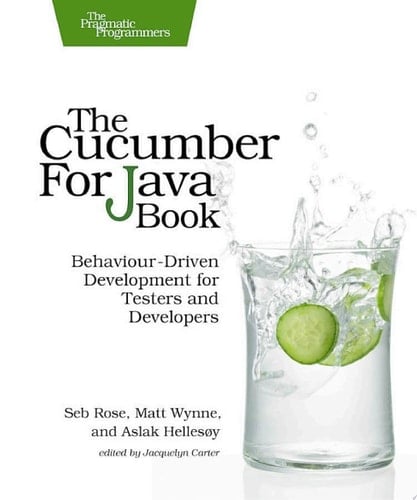
The Cucumber for Java Book Behaviour-Driven Development for Testers and Developers
0
0
Author Description
Until now it's been difficult for teams developing Java applications to learn how to benefit from Behaviour-Driven Development ( BDD ). This book changes all that by describing in detail how to use Cucumber to harness the power of plain language specifications in your development process. In part 1, you'll discover how to use Cucumber's Gherkin DSL to describe the behavior your customers want from the system. You'll also learn how to write Java code that interprets those plain language specifications and checks them against your application. Part 2 guides you through a worked example, using Spring, MySQL, and Jetty. Enhanced chapters teach you how to use Selenium to drive your application and handle asynchronous Ajax calls, and new chapters cover Dependency Injection (DI) and advanced techniques to help keep your test suites fast. Part 3 shows you how to integrate Cucumber with your Continuous Integration (CI) system, work with a REST web service, and even use BDD with legacy applications. Written by the creator of Cucumber and two of its most experienced users and contributors, The Cucumber for Java Book is an authoritative guide that will give you and your team all the knowledge you need to start using Cucumber with confidence.!>https://a.pragprog.com/cms/pip/Cucumber%20Logo__7opd0z__.png"! The Cucumber for Java Book – Q&A What is Cucumber? Cucumber lets software development teams describe how software should behave in plain text. The text is written in a business-readable domain-specific language and serves as documentation, automated tests, and collaborative development-aid—all rolled into one format. Who is this book for? The first part of this book is for the whole team—customer, product owner, business analyst, developer, tester, architect, Scrum master, and anyone else you can think of. The rest of the book focuses on more technical aspects of Cucumber for Java and is
Page Count:
338
Publication Date:
2015-02-15
ISBN-10:
1680504983
ISBN-13:
9781680504989