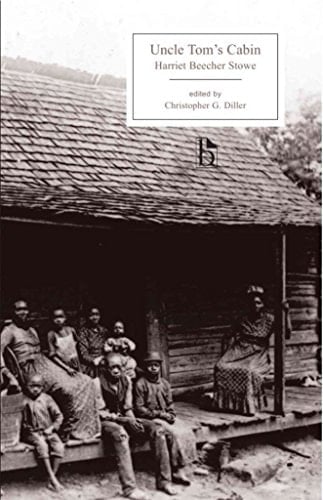
Author Description
From AudioFileUsing a mixture of clearly distinguished voices, Ricco Ross brings Southern accents, Negro dialects, and another era to life in this rendering of UNCLE TOM'S CABIN. Listeners can almost see the young Negro quadroons, Jim Crow, and Topsy, who says, "I just growed," when asked when and where she was born. While Ricco portrays the ugly slave master, Simon Legree, with menacing tones of cruelty, he switches to sounds of compassion and grace with Uncle Tom. Ricco depicts the barbarisms of slave trading in which men, women, and children are bought and sold like livestock with chilling reality. This timeless classic is worth revisiting. G.D.W. © AudioFile 2001, Portland, Maine-- Copyright © AudioFile, Portland, MaineProduct DescriptionOriginally published in 1878. This volume from the Cornell University Library's print collections was scanned on an APT BookScan and converted to JPG 2000 format by Kirtas Technologies. All titles scanned cover to cover and pages may include marks notations and other marginalia present in the original volume.ReviewUncle Tom s Cabin is the most powerful and enduring work of art ever written about American slavery. --Alfred Kazin, American writer and award-winning literary criticUpon meeting Stowe, Abraham Lincoln allegedly remarked, 'So this is the little lady who started this new great war!' --.One of the greatest productions of the human mind. --TolstoyExcerpt. © Reprinted by permission. All rights reserved.From Amanda Claybaugh's Introduction to Uncle Tom's CabinThe publication of Uncle Tom's Cabin lifted Stowe out of a purely Beecher orbit and put her in the stratosphere of international fame. But the novel is nonetheless indebted, as Joan D. Hedrick shows in her Harriet Beecher Stowe: A Life (1994), to the many and varied Beecher family projects. The father's battle for the soul of the nation, the brothers' Christian ministries, one sister's advocacy for women and slaves, another's celebration of the properly run home-all of these can be found in Uncle Tom alongside Stowe's own gifts: her ear for dialect and her eye for detail, her masterful handling of suspense and pathos, and her sympathetic embrace of all the nation's regions. The result was a novel more popular, and more influential, than anyone could have imagined.When Calvin Stowe negotiated Uncle Tom's contract on his wife's behalf, he confided to the publishers that he hoped the novel would be successful enough so that his wife could buy a "good black silk dress" (Thomas F. Gossett, Uncle Tom's Cabin and American Culture, 1985, p. 165). The novel turned out, of course, to be far more successful than that. Within the first week of publication, Uncle Tom's Cabin sold 10,000 copies; within its first year, 300,000 (this in a nation with a total population of only 24 million). Uncle Tom's Cabin was the first American novel to sell more than a million copies, and no book of any kind, except for the Bible, had ever sold so well. Astonishing as the sales figures are, even they fail to suggest the full extent of Uncle Tom's popularity. For the book was published in an era when novels were still treated as a kind of communal property, borrowed from circulating libraries, passed from hand to hand, read aloud to entire households at a time; knowing this, one reviewer speculated that Uncle Tom had ten readers for every copy sold.The best measure of Uncle Tom's popularity lies, then, not in numbers, but rather in the kind of anecdotal evidence that Thomas F. Gossett has collected in the book noted above. Reading through the letters and journals of Stowe's contemporaries, Gossett finds Richard Henry Dana, Jr., noting that four men were reading Uncle Tom in a single railway car and Ralph Waldo Emerson observing that it was the "only book that found readers in the parlor, the nursery, and the kitchen in every house-hold" (p. 165). Such popularity produced a flood of subsidiary merchandise, as Eric J. Sundquist recalls in hi
Page Count:
588
Publication Date:
1965-01-01
ISBN-10:
0198123043
ISBN-13:
9780198123040
Fiction
History
Romance
Politics & Social Sciences
Classics
Literary
New Used & Rental Textbooks
Ethnic Studies
Literature & Fiction
Community Tags
Reader Comments
Share Your Thoughts
No comments yet. Be the first to share your thoughts!