Author Description
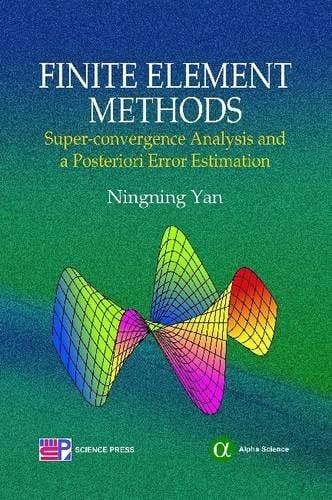
The purpose of this book is to give an essentially self-contained presentation of the mathematical theory underlying the global superconvergence analysis and the recovery type a posteriori error estimates. The book tries to summarize most of the research results on global superconvergence analysis completed by the author and her colleagues, especially by Professor Q. Lin's group. The most basic material in this book is taken from another earlier Chinese book, entitled Structure and Analysis of Efficient Finite Element Methods, written by Professor Q. Lin and author in 1996. Instead of using the Green function theory as the theoretical basis as in most other earlier books on superconvergence, the global superconvergence analysis in this book is based on the so-called integral identity technique. For a posteriori error estimates, this book focuses on the recovery type a posteriori error estimate, which is more close to the superconvergence analysis in its theoretical analysis. This book is intended for postgraduate and graduate students, university teachers, scientists and engineers, who study or are engaged in computational mathematics, computational mechanics, applied mathematics, scientific and engineering computation or other related special fields. A desirable mathematical background for reading this book includes the basic knowledge of partial differential equations, functional analysis, numerical PDE, including Sobolev spaces and finite element theory. But because this book does not use the very deep mathematical theory, it also can be understood by students and engineers who are only familiar with calculus.
Page Count:
227
Publication Date:
2012-01-01
ISBN-10:
1842657186
ISBN-13:
9781842657188