Author Description
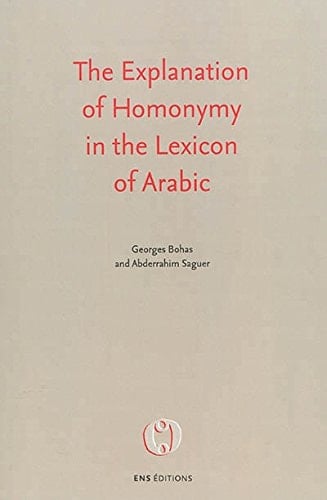
The phenomenon of homonymy appeared at the conceptual beginnings of Ar abic grammar. In the chapter devoted to the relationship between form and lexical meaning in the kitâb by Sîbawayhi we read that it is possi ble to find in the spoken language of the Arabs "two concordant forms although the meanings differ, when you say: wajadtu? alayhi (I felt re sentment against him), which comes from al-mawjidatu (resentment) and wajgadtu (I found) if you look at wijdana l-? allati (to find the lost animal). Examples of this kind are numerous". Throughout the centurie s nobody has been able to provide a satisfactory explanation of this p henomenon. Standard linguistic studies restrict themselves to the level of the ro ot, whereas this phenomenon can only be accounted for at the submorphe mic level. As posited in the Theory of Etymons and Matrices (TME), the minimal phonetic units of the lexicon are not phonemes but phonetic f eatures and the minimal units of sound and meaning are not morphemes b ut matrices composed of vectors of phonetic features correlated to a n otional invariant. In this book we account for some fifty roots (in the traditional meani ng of the term). Such a large number cannot be dismissed as just a han dful of convenient examples chosen for the purpose. Within the framewo rk of TME, homonymy is thus an ordinary phenomenon which is predicted and explained by the theory and every case of homonymy will have an ex planation once the entire lexicon has been described.
Page Count:
189
Publication Date:
2014-01-01
ISBN-10:
2847884084
ISBN-13:
9782847884081