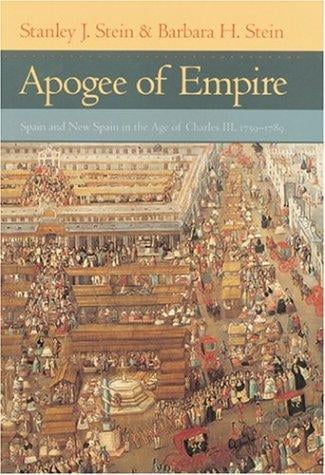
Author Description
"In Apogee of Empire, the authors argue that the inability to renovate the Hapsburg legacies reflected reluctance to undertake radical changes first at home, then in Spain's relationship with its colonies." "The Steins trace in detail efforts to reform the Spanish establishment in the early 1760s, initially under the leadership of the marques de Esquilache, who accompanied Charles from Naples. Reformers had to determine which adjustments could be made without risking radical innovation. The ensuring seven-year conflict between reformers and traditionalists ended in a coup that outsted Esquilache. The authors then analyze the shift in focus to the colonies and the emphasis on incrementally modifying a key element of Spanish colonialism, transatlantic trade, via so-called free trade within the imperial system. Comercio libre, like most Bourbon reformism in general, neither realized a colonial pact nor improved Spain's competitive position in the Atlantic trading system. At the time of Charles III's death, the authors conclude, Spain had only made superficial changes, rather than the profound transformation the situation demanded, and by 1789 Spain and its wealthiest colony, New Spain, would be ill-prepared for the coming decades of upheaval in Europe and America."--Jacket.
Page Count:
480
Publication Date:
2003-01-01
ISBN-10:
0801873398
ISBN-13:
9780801873393
History