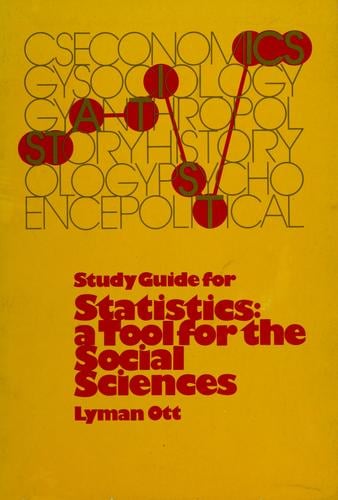
Author Description
The study of statistics can be much like the study of a foreign language. In order to understand the key concepts of statistics and the role of statistics in the social sciences, a student must first memorize and master the vocabulary of statistics. While this is not as formidable a task as it is with a foreign language, a student may become discouraged, disenchanted, and hopelessly lost without this background. This study guide is written in a concise, organized manner. Each section has been developed to probe a student's understanding of the statistical vocabulary and techniques presented in corresponding sections of "Statistics: A Tool for the Social Sciences" by W. Mendenhall, L. Ott, and R. Larson (Duxbury Press). Key words, entries in formulas, and answers to worked examples have been omitted from the body of the study guide and listed in the margins of the pages. The study guide is designed to be used in conjunction with the text. Section titles in the study guide will be followed by a number in parentheses indicating the appropriate reference section in the text. Having read the pertinent textual material, a student may then use the study guide as an individual study aid. The margin of a page should be covered until the student supplies his response for each blank. Review exercises given at the end of each chapter of the study guide offer a student another chance to test his grasp of the pertinent concepts, definitions, and techniques. Answers to these exercises are provided at the back of the study guide. In addition, numerous worked examples are presented in the body of the study guide. Several comments should be made concerning the examples and review exercises of the study guide. Many practical statistical problems in the social sciences involve large sample sizes: hence these data sets, by their very nature, are difficult to manipulate. Without sacrificing practicality, we have tried to present smaller data sets in the exercises and examples. Thus, we hope the student will spend less time on the calculations and more time practicing a wide variety of problems. Even the frequency tables are smaller and may contain fewer than 10 class intervals. This should not distract from the student's ability to derive pertinent information from data presented in a frequency table, and, most likely, will enable him to work more problems of a similar nature.
Page Count:
174
Publication Date:
1974-01-01
ISBN-10:
0878720758
ISBN-13:
9780878720750
Science