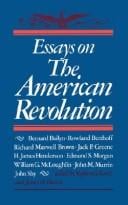
Author Description
The product of the celebrated Symposium on the American Revolution held March 8-12, 1971, by the Institute of Early American History and Culture, this volume contains eight original essays by a group of America's most distinguished scholars. In the opening and closing essays Bernard Bailyn and Edmund S. Morgan interpret the meaning and significance of the Revolution. The themes of the other six essays are the long-term, underlying causes of the war; violence and the Revolution; the military conflict; politics in the Continental Congress; the role of religion in the Revolution; and the effect of the war on the social order. Jack P. Greene discusses the preconditions of the Revolution, assessing the importance of each of the factors that precipitated the war. William G. McLoughlin, by extending his vision to the Civil War, presents a new and arresting interpretation of the effect of the Revolution on religion. John Shy questions how revolutionary the American Revolution was. Richard Maxwell Brown shows how the war arose from a matrix of violence in contemporary British and American societies and reminds us that the struggle for independence was not an unmitigated blessing in that it allowed violence to become legitimate in America. H. James Henderson, using roll-call analysis, describes and interprets the shifting factional divisions in the Continental Congress. And, finally, Rowland Berthoff and John M. Murrin present a provocative inquiry into the impact of the war on American society, arguing that if it did nothing else, the Revolution prevented a feudal revival in America. These essays will be indispensable to all students of the American Revolution and should help to shape writings on the subject for many years to come. -From the dust jacket.
Page Count:
320
Publication Date:
1973-01-01
ISBN-10:
0807812048
History