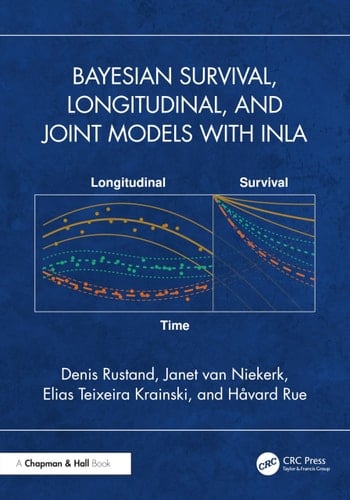
Bayesian Survival, Longitudinal, and Joint Models with Inla
0
0
Author Description
<p>This book provides a comprehensive and practical guide to fitting complex Bayesian survival, longitudinal and joint models using the Integrated Nested Laplace Approximations (INLA) methodology, a powerful and computationally efficient alternative to traditional MCMC methods. Aimed at graduate students, researchers, and applied statisticians in biostatistics, epidemiology, and public health, this book addresses the critical challenge of analyzing high-dimensional and correlated data. It demonstrates how to move beyond the computational limitations of conventional methods, enabling the analysis of sophisticated models that were previously out of reach.</p><p>Through a series of clear, fully reproducible examples, readers will learn to: </p><p>- Implement a wide range of survival models, including proportional hazards, competing risks, multi-state, cure, and frailty models.</p><p>- Fit various longitudinal models for continuous, count, binary, semicontinuous, and ordinal data.</p><p>- Construct and interpret joint models that link multiple longitudinal markers to single or multiple survival outcomes using various association structures.</p><p>- Incorporate spatial random effects to account for spatial autocorrelation in areal and point-referenced data.</p><p>This book is the result of a unique collaboration between the creators and key developers of the INLA methodology. The lead author, Denis Rustand, is the developer of the INLAjoint R package, which serves as the primary software for the methods described. Håvard Rue is the principal architect of the INLA methodology and the R-INLA package. Janet van Niekerk is an expert in efficient Bayesian methods for complex survival analysis and a core INLA developer. Elias Teixeira Krainski is a renowned specialist in the theory and application of spatial statistics with INLA.</p>
Page Count:
320
Publication Date:
2026-04-28
ISBN-10:
1041087691
ISBN-13:
9781041087694