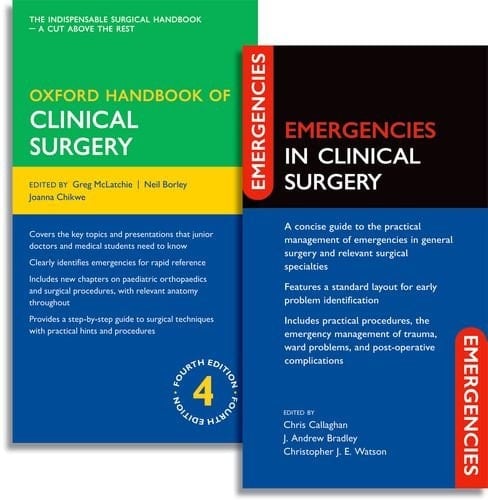
Oxford Handbook of Clinical Surgery and Emergencies in Clinical Surgery Pack (Oxford Handbooks)
0
0
Author Description
Product Description Two titles from the bestselling Oxford Handbook and Emergencies in... series are available together in this great value pack.The Oxford Handbook of Clinical Surgery has been thoroughly revised to include brand new chapters on Paediatric Orthopaedics and Common Surgical Procedures, as well as new presentations, illustrations, and new anatomy and emergency indexes to aid quick reference. It is an invaluable tool for juniorsurgical trainees, medical students, nursing, paramedical, and rehabilitation staff. The handbook covers the assessment and preparation of the patient, anaesthesia and critical care, inflammation, wound healing and infection, and the key components of general surgical practice, as well as chapterson other surgical specialties, including plastic, paediatric, and orthopaedic surgery. There are step-by-step descriptions of common operative surgical techniques, practical hints and procedures, and information on signs, symptoms and rarities. Emergency presentations are clearly identified forrapid reference and investigations and management plans are set out in a clear and easy-to-follow way. Surgically relevant anatomy and physiology has been expanded for each area, quick reference symbols ensure the reader is guided to key facts, and there is an increased focus on evidence-basedpractice with key references throughout. A cut above the rest, this is the essential guide to clinical surgery and the surgical specialities. Emergencies in Clinical Surgery aims to make the life of junior surgeons easier through providing a quick-reference, practical guide to common emergency surgical problems and trauma. It is written in an easily accessible, concise style, and is in a pocket-sized format that means that readers areable to refer to it on the ward, or on the way down to the Emergency Department. The use of icons indicating the degree of urgency for each condition helps to focus the mind of the reader and aid in the identification of true emergencies. Part 1 deals with three different approaches to the sick surgical patient, as well as communication and how to prepare the patient for emergency surgery, endoscopy, or interventional radiology. Part 2 is concerned with the assessment and management of trauma emergencies, the acute abdomen, and wardemergencies. Conditions are cross-referenced to more detailed topics in Part 3 ('Disease-based emergency surgery'). This contains a fuller description of individual diseases with comments on initial and further investigations and management. Specific early complications after surgery, endoscopy, andinterventional radiology are also dealt with. Finally, Part 4 describes how to perform common procedures, along with their indications, contraindications, and post-procedure care. About the Author Greg McLatchie, Consultant Surgeon, Hartlepool General Hospital, Hartlepool, UK,Neil Borley, Consultant Colorectal Surgeon, Cheltenham General Hospital, Cheltenham, UK,Joanna Chikwe, Associate Professor of Cardiothoracic Surgery, Mount Sinai Medical Center, New York, USA,Chris Callaghan, ClinicalLecturer and Honorary Specialist Registrar, Department of Surgery, University of Cambridge, UK,J. Andrew Bradley, Professor of Surgery, University of Cambridge and Honorary Consultant Surgeon, Addenbrooke's Hospital, Cambridge, UK,Christopher Watson, Senior Lecturer, University of Cambridge andHonorary Consultant Surgeon, Addenbrooke's Hospital, Cambridge, UKMr Neil Borley trained at Guy's Hospital Medical School, Cambridge, Canterbury and Oxford. He is a Consultant Colorectal Surgeon with an interest in the education and training of undergraduate and postgraduate students of basic sciences and surgery. He is also an examiner in surgery.
Page Count:
1408
Publication Date:
2013-05-19
ISBN-10:
0199680353
ISBN-13:
9780199680351
Community Tags
Reader Comments
Share Your Thoughts
No comments yet. Be the first to share your thoughts!