Author Description
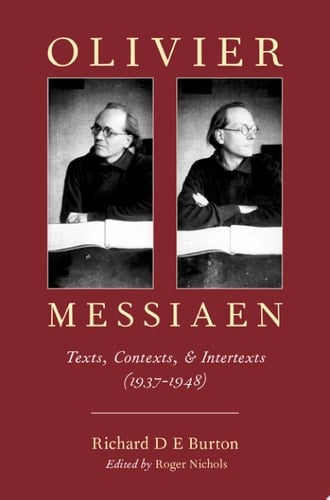
The 20th century French composer Olivier Messiaen was a devout Roman Catholic and notably claimed that his music was an expression of his faith. Unsurprisingly, many performers and listeners consider Messiaen's strong religiosity central to their appreciation of the composer's music. Music scholars have devoted much energy to exploring how Messiaen's music was an extension of his religious beliefs. Yet, these works tend to discuss Messiaen's Catholicism solely in terms of personal religious identity and ignore the composer's broader connections to the cultural landscape of Roman Catholicism in France.In Olivier Messiaen: Texts, Contexts, and Intertexts (1937-1948) the late French literature scholar Richard Burton examines nine of Messiaen's works in the context of the broader French Catholic intellectual tradition. Drawing on an expansive knowledge of the Catholic literature and the surrealist tradition, Burton reveals that Messiaen's middle-period compositions are filled with intertextual references to the Bible and other theological writings, which Messiaen, given his reputation for falsifying facts, may have gone to great lengths to obscure. As a Catholic, Messiaen is presented as somewhat removed from the ethos of his time and place, taking no part in the social side of Catholicism that found expression in the Pétainist litany of 'Patrie, Famille, Travail'. Rather, Messiaen regarded himself as having a 'vertical' relationship with God, which could make him seem unworldly and even uncaring. With insights into the artistic careers of Messiaen's notable contemporaries and historical perspectives on the breakdown of French politics during World War II, Burton creates a vivid picture of the previously unexamined spiritual and philosophical inspirations behind Messiaen's pivotal mid-century compositions.
Menrva's Summary
THE THESIS
How did the broader French Catholic intellectual tradition shape the compositions of Olivier Messiaen during the pivotal years of 1937 to 1948? Richard D. E. Burton, a scholar of French literature, challenges the conventional view that Messiaen's music was solely an expression of personal piety. By analyzing nine specific works, Burton argues that Messiaen's output is deeply embedded in the theological and literary landscape of mid-century France, often containing obscured intertextual references that contradict the composer's own public narratives.
THE SCOPE MAP
What You Will Find
- Analysis of nine compositions written between 1937 and 1948
- Examination of intertextual links between Messiaen's music and theological literature
- Comparative study of Messiaen against the backdrop of the Pétainist era and French surrealism
Scope Limits
- The study focuses primarily on the middle period of the composer's career
- The analysis does not provide a comprehensive biography of the composer's entire life
THE AUTHORITY PERSPECTIVE
Scholars and musicologists recognize this work as a significant contribution to the study of Messiaen's intellectual influences. Readers frequently note the academic density of the prose and the author's extensive knowledge of French cultural history.
Page Count:
264
Publication Date:
2016-09-01
ISBN-10:
0190277947
ISBN-13:
9780190277949
Biography
MUSICOLOGY
Musical Genres
Categories
Kindle Store
Kindle eBooks
French History
Theology