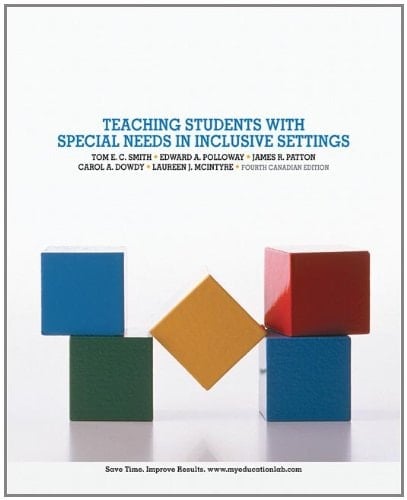
Teaching Students with Special Needs in Inclusive Settings, Fourth Canadian Edition with MyEducationLab (4th Edition)
0
0
Author Description
Product description Teaching Students with Special Needs in Inclusive Settings offers Canadian students an overview of students with disabilities, particularly those with high-incidence special needs. The text follows the authors’ belief that students with exceptionalities should be included with other typically achieving but chronological-age peers, but should also be provided with the educational services appropriate for them. Unlike other texts in the discipline, Teaching Students both highlights the similarities and differences across Canada and frequently contrasts the Canadian situation with that of the US so that students are best informed about current special education practices throughout all of North America. Well-written and easy-to-read, this text offers a balanced presentation of theory and practice that students enjoy using, with evidence-based teaching suggestions that are very clear and helpful. Review “It [the text] is wide yet not too deep for a cursory course in special ed.” --Thomas G. Ryan, Nipissing Faculty of Education “Yes [I would adopt the new edition of this book]!!! This is my favourite text to date.” --Angela Wilm, Lakeland College “The Smith, et. al. text offers a well-balanced presentation of theory and practice….Students have enjoyed this book and they find the suggestions for teaching very clear and helpful. It is also well written and easy to read.” --Elsa Lo, Concordia University About the Author Tom E.C. Smith is currently Professor and Head of the Department of Curriculum and Instruction at the University of Arkansas. He has been on the faculties of the University of Arkansas at Little Rock, the University of Alabama at Birmingham, and the University of Arkansas for Medical Sciences. Prior to receiving his Ed.D. from Texas Tech University, Tom taught children with intellectual disabilities, learning disabilities, and autism at the elementary and secondary levels. President Clinton appointed him to three terms on the President’s Committee on Mental Retardation. He has served as the Executive Director of the Division on Developmental Disabilities of the Council for Exceptional Children since 1996. Tom’s current professional interests focus on legal issues and special education. Edward A. Polloway is a Professor of Education and Human Development at Lynchburg College in Virginia, where he has taught since 1976. He also serves as Vice-President for Graduate Studies and Community Advancement. He has served twice as president of the Division on Developmental Disabilities of the Council for Exceptional Children and on the board of directors of the Council for Learning Disabilities. He also served on the committee that developed the 1992 definition of mental retardation for the American Association on Mental Retardation. He is the author of 12 books and 100 articles in the field of special education, with primary interests in the areas of learning disabilities and mental retardation. James R. Patton is an Educational Consultant and Adjunct Associate Professor at the University of Texas at Austin. He received his Ed.D. from the University of Virginia, and is a former high school biology teacher and elementary-level special education resource teacher. He has taught students who were gifted and some who were gifted/learning disabled. James’s professional interests include transition, life skills instruction, adult issues related to individuals with special needs, behavioural intervention planning, and classroom accommodations. He has served on national boards of the Division on Developmental Disabilities, the Council for Learning Disabilities, and the National Joint Committee on Learning Disabilities. Carol A. Dowdy is Professor of Special Education at the University of Alabama at Birmingham, where she has taught since receiving her Ed.D. degree from the University of Alabama, Tuscaloosa. She was written eight books on special education and published 34 articles on learning disabilities. Carol has se
Page Count:
448
Publication Date:
2011-03-15
ISBN-10:
0205150748
ISBN-13:
9780205150748
Certification & Development
Special Education
Schools & Teaching
Community Tags
Reader Comments
Share Your Thoughts
No comments yet. Be the first to share your thoughts!