Author Description
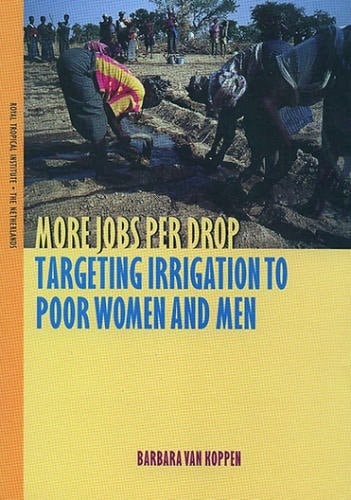
"If irrigation agencies target their support and vest rights to irrigated land and water in poor men and women, mainstream irrigation development can make a substantive contribution to gender-equitable poverty alleviation. Access to these vital resources can not only improve the economic and non-economic well-being of the poor, but also - under many conditions - can increase the productivity of smallholders' land to the extent that investments in small farms may be a better way of reaching production goals than investments in large farms. That is, the assumption that there is necessarily a trade-off between poverty alleviation and production is not true. Clearly, however, this is valid only if the ecological resource base is used sustainably. 'More jobs per drop: targeting irrigation to poor women and men' analyzes the role of governmental and non-governmental irrigation agencies in including or excluding poor men and especially poor women as right holders, using a review of literature from across the world plus two in-depth field studies on irrigation support for rice cultivation. In Southwest Burkina Faso, where rice cultivation is a female cropping system, a state-financed rice valley development project is studied. In Bangladesh, where irrigated rice cultivation is a male cropping system, the focus is on NGO-supported ownership of private pumps by groups of functionally landless women who sell the water as well as using it to irrigate their own household land. This empirical basis is then used to identify factors that are critical to effective targeting of organizational, technical and financial support by agencies."--Page 4 of cover.
Page Count:
187
Publication Date:
1998-01-01
ISBN-10:
9054859105
ISBN-13:
9789054859109