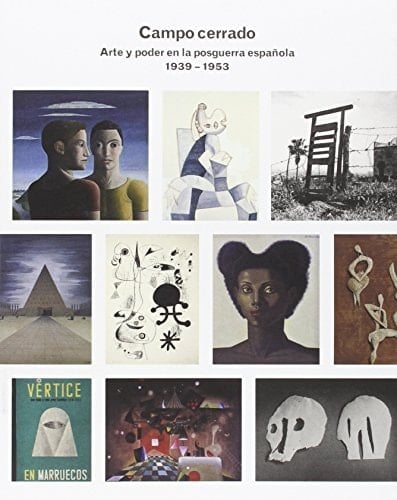
Campo cerrado arte y poder en la posguerra española, 1939-1953
0
0
Author Description
The exhibition 'Campo Cerrado' takes its name from the homonymous novel by Max Aub and looks to examine Spanish art in the complex and controversial 1940s, a decade that has received little attention and one that exists in a critical and historiographical vacuum, despite its importance in structuring modern sensibility in Spain.00In 1938, at the height of the Civil War, Eugenio d?Ors, General Director of Fine Arts, selected works by Spanish artists linked to the art that preceded the conflict, including Zuloaga, representing Spain?s fascist camp at the Venice Biennale. In 1951, the writer and critic Rafael Santos Torroella and architect José Antonio Coderch designed the Spanish Pavilion for the IX Milan Triennale, thus setting up a dialogue between popular craftsmanship and contemporary design which included both Lorca?s poetry and the paintings of a young Guinovart. The comparison between the contents of Spain?s representations at both international events, which could bee seen as symbolic boundaries in this exhibition, could also evoke a linear evolution ranging from the most academic conservatism, in line with the rigours of early fascism, to the opening out of modernity, in keeping with a political time that strove to put an end to the international isolation of the France regime. Nevertheless, the analysis of how much lies beneath, not only in both exhibitions but also in the intervening time between the two, reveals an infinitely more complex reality.00Exhibition: Museo Nacional Centro de Arte Reina Sofía, Madrid, Spain (26.04.-26.09.2017).
Page Count:
398
Publication Date:
2016-01-01
ISBN-10:
848026537X
ISBN-13:
9788480265379
Community Tags
Reader Comments
Share Your Thoughts
No comments yet. Be the first to share your thoughts!