Author Description
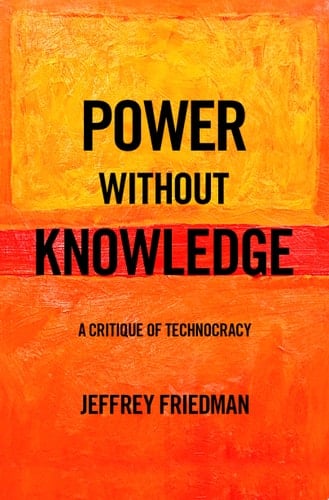
Technocrats claim to know how to solve the social and economic problems of complex modern societies. But as Jeffrey Friedman argues in Power without Knowledge, there is a fundamental flaw with technocracy: it requires an ability to predict how the people whom technocrats attempt to control will act in response to technocratic policies. However, the mass public's ideas-the ideas that drive their actions-are far too varied and diverse to be reliably predicted.But that is not the only problem. Friedman reminds us that a large part of contemporary mass politics, even populist mass politics, is essentially technocratic too. Members of the general public often assume that they are competent to decide which policies or politicians will be able to solve social and economic problems. Yet these ordinary "citizen-technocrats" typically regard the solutions to social problems as self-evident, such that politics becomes a matter of vetting public officials for their good intentions and strong wills, not their technocratic expertise.Finally, Friedman argues that technocratic experts themselves drastically oversimplify technocratic realities. Economists, for example, theorize that people respond rationally to the incentives they face. This theory is simplistic, but it gives the appearance of being able to predict people's behavior in response to technocratic policy initiatives. If stripped of such gross oversimplications, though, technocrats themselves would be forced to admit that a rational technocracy is nothing more than an impossible dream.Ranging widely over the philosophy of social science, rational choice theory, and empirical political science, Power without Knowledge is a pathbreaking work that upends traditional assumptions about technocracy and politics, forcing us to rethink our assumptions about the legitimacy of modern governance.
Menrva's Summary
THE THESIS
This book investigates the fundamental epistemic limitations of technocratic governance and the inherent unpredictability of human behavior in response to policy. Jeffrey A. Friedman, a scholar of political science and philosophy, challenges the assumption that experts can reliably predict social outcomes. By synthesizing rational choice theory with the philosophy of social science, he argues that the diversity of public ideas renders technocratic control impossible and exposes the oversimplifications inherent in modern policy-making.
THE SCOPE MAP
What You Will Find
- Analysis of the epistemic requirements for successful technocratic policy.
- Critique of rational choice theory and its application to mass behavior.
- Examination of the 'citizen-technocrat' phenomenon in populist politics.
- Philosophical inquiry into the legitimacy of modern governance.
Scope Limits
- The text does not provide a specific alternative policy framework or a blueprint for governance reform.
- It focuses primarily on the theoretical and epistemic failures of technocracy rather than historical case studies of specific administrative failures.
THE AUTHORITY PERSPECTIVE
Scholars and political theorists frequently note the high level of academic rigor and philosophical density present in Friedman's arguments. The work is often cited as a significant contribution to the critique of expert-led governance and the limitations of social scientific prediction.
Page Count:
408
Publication Date:
2020-01-15
ISBN-10:
0190877170
ISBN-13:
9780190877170
Philosophy
Economics
Sociology
TECHNOCRACY
Public Policy
Governance