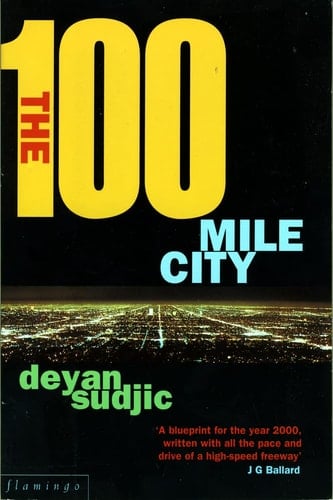
Product DescriptionThe new architectural shape of five world cities-London, Paris, New York, Tokyo, and Los Angeles. Sudjic tells how cities grow and change through their buildings and how people live and work in them. "Written with all the pace and drive of a high-speed freeway... Powerful and convincing" (J. G. Ballard). Index; photographs by Phil Sayer.From Publishers WeeklyThis well-written book, a British import, is full of perceptive, wide-ranging observations on the evolution of the "multilayered new city"--concentrating mainly on London, Paris, New York, Tokyo and Los Angeles. Sudjic, a London editor and critic who was trained as an architect, is neither nostalgic nor pollyannish, finding both vitality and ugliness in the modern city. Pointing to London's Canary Wharf and New York's World Financial Center, he argues that the property developer--not the architect or city planner--is most responsible for shaping the city. Yet planners still have power: Sudjic limns the Grands Projets , Francois Mitterrand's attempt to remodel Paris, and discusses the need for good planning in the dystopia of Houston. Most interesting are Sudjic's expositions of how the museum has become the "replacement for the missing agora," and how the airport has become the new city square. A city's transport plan helps create its public life, and the author contrasts Tokyo's dependence on public transport with the worldwide ascendance of the automobile. We must, he concludes, learn new ways to analyze and assess life in the modern city.Copyright 1993 Reed Business Information, Inc.About the AuthorDeyan Sudjic is director of the Design Museum, London, UK.Before moving to his post at the Design Museum, he contributed to Schoolkids OZ, was the design and architecture critic for The Observer, the Dean of the Faculty of Art, Design and Architecture at Kingston University and Co-Chair of the Urban Age Advisory Board.In 1983 he founded Blueprint, the monthly architecture magazine and went on to be first the magazine's editor and then its editorial director. From 2000 to 2004, he was the editor of Domus (magazine).Alongside these roles, he was the Director of The Glasgow UK City of Architecture and Design program in 1999 and the Director of the Venice Architecture Biennale in 2002. He was also a juror for the design of London’s Aquatics Centre, which is to be built for the 2012 Olympics from a design by the architect Zaha Hadid.From Kirkus ReviewsFace it, the urban center cannot hold: This, in essence, is the message of British architecture-writer Sudjic's sweeping discussion of modern cities, especially those he deems the world's greatest: New York, Los Angeles, London, Paris, and Tokyo. Hammering away with the now familiar observation that cities are spreading beyond their old boundaries, decaying in the center and reshaping themselves on the edges, Sudjic is especially impatient with those who idealize the urban past and what he calls the ``myth'' of community, and who are obsessed with saving ``elderly buildings'' even at the cost of displacing the poor. It's not that Sudjic glorifies current trends; he has as much distaste as those he criticizes for beltway office clusters ``where it is impossible to walk out at lunch time to the pub or cafe''; the centerless city that's Houston today (``you feel an emptiness everywhere''); the museum's new commercialism; huge warehouse stores like Ikea (shopping there ``makes life just a little more brutal''); and 80's overdevelopment in general. And, like everyone else, he deplores the massive public-housing projects that have only made low-income housing problems worse. Sudjic tries hard to defend ugly L.A., for example, from lovers of the ``picturesque''; to recognize airports as what he sees as authentic urban places; even to see Houston's vast void as ``exhilarating possibility.'' Yet the tone here is far from exhilarated. Even an early rundown of urban theorists and architects consis
Page Count:
364
Publication Date:
1993-09-13
Politics & Social Sciences
Cultural
Landscape
Architecture
Social Sciences
Urban
Sociology
Anthropology
Arts & Photography
Urban & Land Use Planning