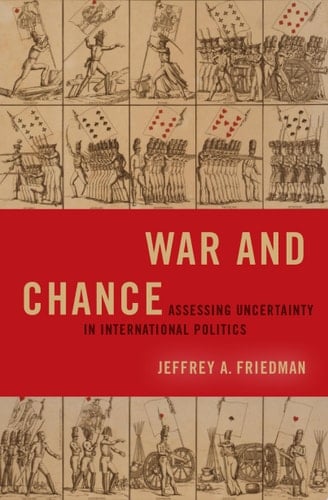
War and Chance: Assessing Uncertainty in International Politics
Part of the Bridging the Gap series
0
0
Author Description
Uncertainty surrounds every major decision in international politics. Yet there is almost always room for reasonable people to disagree about what that uncertainty entails. No one can reliably predict the outbreak of armed conflict, forecast economic recessions, anticipate terrorist attacks, or estimate the countless other risks that shape foreign policy choices. Many scholars and practitioners therefore believe that it is better to keep foreign policy debates focused on the facts - that it is, at best, a waste of time to debate uncertain judgments that will often prove to be wrong.In War and Chance, Jeffrey A. Friedman shows how foreign policy officials often try to avoid the challenge of assessing uncertainty, and argues that this behavior undermines high-stakes decision making. Drawing on an innovative combination of historical and experimental evidence, he explains how foreign policy analysts can assess uncertainty in a manner that is theoretically coherent, empirically meaningful, politically defensible, practically useful, and sometimes logically necessary for making sound choices. Each of these claims contradicts widespread skepticism about the value of probabilistic reasoning in international politics, and shows how placing greater emphasis on assessing uncertainty can improve nearly any foreign policy debate.A clear-eyed examination of the logic, psychology, and politics of assessing uncertainty, War and Chance provides scholars and practitioners with new foundations for understanding one of the most controversial elements of foreign policy discourse.
Menrva's Summary
THE THESIS
This book investigates the pervasive challenge of assessing uncertainty in international politics and argues that probabilistic reasoning is essential for sound foreign policy decision-making. Jeffrey A. Friedman, a scholar in the field of international relations, utilizes a combination of historical case studies and experimental data to challenge the common skepticism toward quantifying uncertainty. He posits that avoiding the assessment of uncertain outcomes undermines high-stakes policy choices and provides a framework for analysts to integrate probabilistic logic into their decision-making processes.
THE SCOPE MAP
What You Will Find
- A theoretical framework for evaluating uncertainty in foreign policy.
- Analysis of the psychological and political barriers to probabilistic reasoning.
- Historical case studies illustrating the impact of uncertainty on international conflict.
- Experimental evidence regarding how analysts process and communicate risk.
Scope Limits
- The text does not provide a predictive model for specific future geopolitical events.
- It does not focus on domestic policy or non-security-related economic forecasting.
THE AUTHORITY PERSPECTIVE
Experts in international relations recognize this work as a significant contribution to the study of foreign policy decision-making and risk analysis. Readers frequently note the academic rigor of the prose, which serves as a foundational text for both scholars and practitioners seeking to improve the quality of policy debates.
Page Count:
240
Publication Date:
2019-05-01
ISBN-10:
0190938021
ISBN-13:
9780190938024
UNCERTAINTY
Security Studies
National security
United States
Decision Making
International relations
Foreign Policy