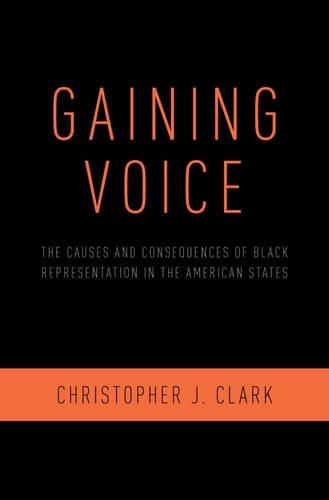
Gaining Voice: The Causes and Consequences of Black Representation in the American States
0
0
Author Description
Scholars studying the causes and consequences of political representation, particularly in terms of gender and race, often turn to a concept called descriptive representation. Descriptive representation tells us the degree to which elected officials resemble their constituents, and whether such a resemblance has a bearing on the way they legislate. In other words, do people vote for candidates of their same racial/ethnic background or gender? If they do, does this affect the type of policies an elected official pursues? Further, if citizens see people who look like them in office, does it have an effect on their political attitudes and participation?In this book, Christopher J. Clark argues that descriptive representation is a more multi-faceted phenomenon than previously shown, particularly when observed at the state level. He contends that black political involvement, political attitudes, and public opinion are contingent on more than being represented by a single black elected official. Rather, they hinge on the proportion of African Americans making up a state legislature--what Clark terms "black seat share"--as well as the degree to which that proportion reflects the demographic makeup of the state. As well, Clark pinpoints the critical mass of African American legislators necessary to initiate the creation of black caucuses, an important institution for minority representation. Clark bases his study on an examination of black representation in state legislatures between 1966 and 2010, looking particularly at black political opinion and involvement in the development of welfare and education policy.
Menrva's Summary
THE THESIS
This book investigates how the descriptive representation of African Americans in state legislatures influences political involvement, public opinion, and policy outcomes. Christopher J. Clark, a scholar of political science, utilizes longitudinal data to challenge the notion that representation is solely defined by the presence of a single elected official. He argues that political impact is instead contingent upon the "black seat share" relative to state demographics and the formation of institutional bodies like black caucuses.
THE SCOPE MAP
What You Will Find
- Analysis of black representation in state legislatures from 1966 to 2010.
- The concept of "black seat share" as a primary metric for legislative influence.
- Examination of the relationship between minority representation and policy development in welfare and education.
Scope Limits
- The study focuses exclusively on the American state level rather than federal or local municipal government.
- The analysis is restricted to the time period between 1966 and 2010.
THE AUTHORITY PERSPECTIVE
Experts identify this work as a significant contribution to the study of descriptive representation and minority political influence. Readers frequently note the academic density of the prose, which provides a rigorous framework for understanding how demographic proportions in government affect legislative behavior.
Page Count:
264
Publication Date:
2019-03-25
ISBN-10:
0190933569
ISBN-13:
9780190933562
Sociology
Comparative Politics
State Politics
Public Policy
Representative government and representation
American Government
United States
African Americans
Race & Ethnicity