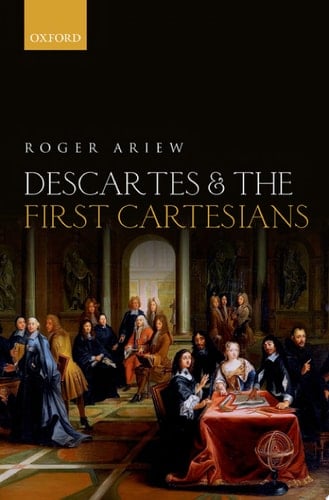
Author Description
Descartes and the First Cartesians adopts the perspective that we should not approach René Descartes as a solitary thinker, but as a philosopher who constructs a dialogue with his contemporaries, so as to engage them and elements of his society into his philosophical enterprise. Roger Ariew argues that an important aspect of this engagement concerns the endeavor to establish Cartesian philosophy in the Schools, that is, to replace Aristotle as the authority there. Descartes wrote the Principles of Philosophy as something of a rival to Scholastic textbooks, initially conceiving the project as a comparison of his philosophy and that of the Scholastics. Still, what Descartes produced was inadequate for the task. The topics of Scholastic textbooks ranged more broadly than those of Descartes; they usually had quadripartite arrangements mirroring the structure of the collegiate curriculum, divided as they typically were into logic, ethics, physics, and metaphysics. But Descartes produced at best only what could be called a general metaphysics and a partial physics. These deficiencies in the Cartesian program and in its aspiration to replace Scholastic philosophy in the schools caused the Cartesians to rush in to fill the voids. The attempt to publish a Cartesian textbook that would mirror what was taught in the schools began in the 1650s with Jacques Du Roure and culminated in the 1690s with Pierre-Sylvain Régis and Antoine Le Grand. Ariew's original account thus considers the reception of Descartes' work, and establishes the significance of his philosophical enterprise in relation to the textbooks of the first Cartesians and in contrast with late Scholastic textbooks.
Menrva's Summary
THE THESIS
How did the early followers of René Descartes attempt to transform his incomplete philosophical framework into a comprehensive pedagogical system capable of replacing Scholasticism in the university curriculum? Roger Ariew, a scholar of early modern philosophy, examines the transition from Descartes' original writings to the structured textbooks produced by his successors. By analyzing the structural deficiencies of Descartes' own work compared to the quadripartite Scholastic tradition, Ariew argues that the first Cartesians were not merely passive interpreters but active architects who expanded Cartesian thought to meet the institutional requirements of the 17th-century academy.
THE SCOPE MAP
What You Will Find
- Comparative analysis of Cartesian texts and late Scholastic textbooks.
- Historical documentation of the 1650s to 1690s pedagogical shift.
- Examination of works by Jacques Du Roure, Pierre-Sylvain Régis, and Antoine Le Grand.
- Analysis of the transition from logic, ethics, physics, and metaphysics curricula.
Scope Limits
- Does not provide a comprehensive biography of René Descartes.
- Does not cover the influence of Cartesianism beyond the academic textbook tradition.
THE AUTHORITY PERSPECTIVE
Scholars recognize this work as a significant contribution to the understanding of how Cartesian philosophy was institutionalized in the 17th century. Experts frequently highlight the text for its rigorous archival research and its ability to contextualize Descartes within the broader intellectual landscape of his contemporaries.
Page Count:
256
Publication Date:
2014-01-01
ISBN-10:
0191036048
ISBN-13:
9780191036040
Philosophy
Early Modern
Cartesianism
Intellectual History
History & Surveys
Philosophy history
Scholasticism