Author Description
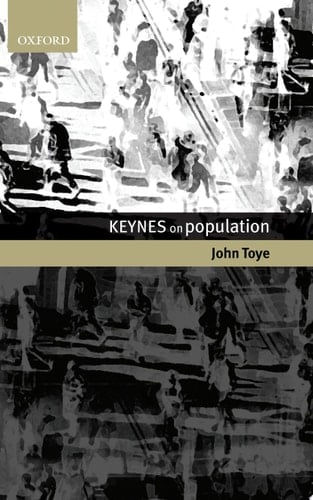
The Topic Of Population Is Treated Only Lightly In The Major Modern Biographies Of John Maynard Keynes, Yet Keynes Himself Had Strong - If Varying - Views On The Subject. For Many Years He Maintained A Neo-malthusian View Of Population, Based On A Postulated Link Between Population Growth And Deteriorating Terms Of Trade. This Led Him To Take Up A Militant Stance Towards 'overpopulated' Countries, Notably India, China, And Egypt. Keynes On Population Publishes Two Of John Maynard Keynes's Manuscripts Not Published In The Collected Writings: His Cambridge Lectures On Population And 1914 Oxford Lecture On 'population'. It Provides A Detailed Commentary On The Text Of 'population' And Discusses The Extent Of Keynes's Engagement With The Social Darwinist Doctrine Of The 'rapid Multiplication Of The Unfit' And With Eugenics. It Then Traces The Subsequent Vicissitudes Of His Views On Population And His Interventions In The Contemporary Politics Of Population. These Include His Part In The 1920s Campaign For Birth Control, The Reversal Of His Neo-malthusianism, And His Eventual Support For Family Allowances.
Menrva's Summary
THE THESIS
This work investigates the evolution of John Maynard Keynes's theories on population and his shifting stance on Neo-Malthusianism throughout his career. John F. J. Toye, an expert in development economics and history, utilizes previously unpublished manuscripts and archival records to reconstruct Keynes's intellectual engagement with demographic trends. The book argues that Keynes's views were far more complex and politically active than standard biographies suggest, moving from early concerns about overpopulation to later advocacy for social policies like family allowances.
THE SCOPE MAP
What You Will Find
- Analysis of two previously unpublished manuscripts: the Cambridge lectures on population and the 1914 Oxford lecture.
- Examination of Keynes's involvement in the 1920s birth control movement.
- Discussion of the influence of Social Darwinism and eugenics on early 20th-century economic thought.
Scope Limits
- The text does not provide a comprehensive biography of Keynes's life outside of his demographic and population-related work.
- It does not offer a modern demographic analysis of the countries Keynes discussed, focusing instead on the historical context of his specific arguments.
THE AUTHORITY PERSPECTIVE
Scholars and economic historians recognize this text as a significant contribution to understanding the nuances of Keynesian thought beyond his macro-economic models. Readers frequently note the academic density of the prose, which provides a rigorous examination of primary source material for those interested in the history of economic ideas.
Page Count:
272
Publication Date:
2000-01-01
ISBN-10:
0191583685
ISBN-13:
9780191583681
History
Biography
Economics
Intellectual History
Demography