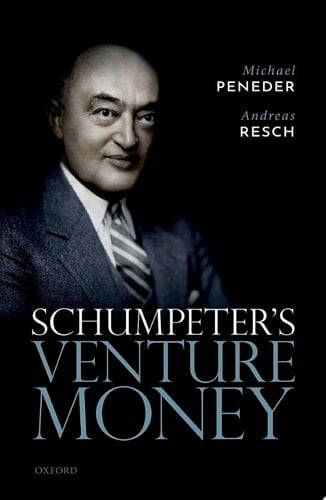
Author Description
Distinctively tying history with theory, political economist Joseph A. Schumpeter reached far back in time to understand what drives economic development and determines its course. Historical and empirical research provided a laboratory for learning. At the same time, he reached for a long-term vision through theoretical inspection and utmost abstraction, seeking to distil a phenomenon's essential nature and function. He believed that good theory can indicate where the economy is headed in the future. Schumpeter's attention to history and theory also informed the plan for this book. Part I trails the historical stream of financial innovations and the scholarly struggle to assimilate them in monetary thought, while Part II focuses on Schumpeter's own monetary theory. Its deliberate reconstruction from scattered sources reveals a strikingly original and still modern conception. Drawing from the detailed study of documents at various archives in Austria, Part III then concentrates on the business history of Schumpeter's failed personal endeavours in banking and as a proto-venture capitalist. Finally, Part IV casts light on the legacy of Schumpeter's monetary ideas on contemporary thought. It depicts how monetary theory initially left them behind, yet has more recently set out to return to his ideas on money, financial innovation, and growth. Overall, a surprisingly coherent picture emerges from the study of Schumpeter's neglected monetary theory, his personal history, and his intellectual legacy on the present day.
Menrva's Summary
THE THESIS
This book investigates the intersection of Joseph A. Schumpeter’s personal financial failures and his theoretical contributions to monetary economics. The authors, Andreas Resch and Michael Peneder, utilize archival research and theoretical reconstruction to bridge the gap between Schumpeter’s abstract economic models and his practical experiences as a failed banker and proto-venture capitalist. By examining his life alongside his intellectual output, the text argues that his neglected monetary theories remain highly relevant to contemporary economic discourse.
THE SCOPE MAP
What You Will Find
- A historical analysis of financial innovations and their integration into monetary thought.
- A systematic reconstruction of Schumpeter’s monetary theory derived from scattered primary sources.
- Detailed archival accounts of Schumpeter’s personal business ventures in the banking sector.
- An evaluation of Schumpeter’s influence on modern economic perspectives regarding growth and financial innovation.
Scope Limits
- The book does not provide a comprehensive biography of Schumpeter’s entire life, focusing primarily on his monetary and financial activities.
- It does not attempt to offer a general history of 20th-century banking beyond the context of Schumpeter’s specific experiences.
THE AUTHORITY PERSPECTIVE
Experts recognize this work as a significant contribution to the history of economic thought, particularly for its success in synthesizing Schumpeter’s fragmented monetary ideas. Readers frequently note the academic density of the prose, which requires a foundational understanding of economic theory to fully appreciate the authors' analytical framework.
Page Count:
403
Publication Date:
2021-01-01
ISBN-10:
0192526553
ISBN-13:
9780192526557
Economics
Biography
Monetary Theory
Financial History
Macroeconomic Theory
Business History