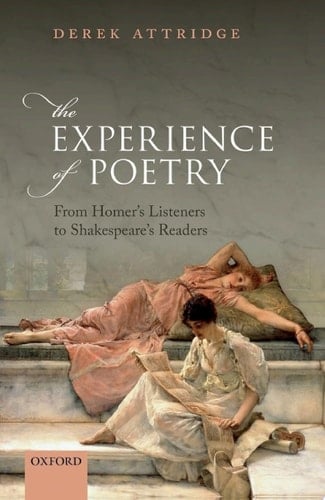
Author Description
Was the experience of poetry--or a cultural practice we now call poetry--continuously available across the two-and-a-half millennia from the composition of the Homeric epics to the publication of Ben Jonson's Works and the death of Shakespeare in 1616? How did the pleasure afforded by the crafting of language into memorable and moving rhythmic forms play a part in the lives of hearers and readers in Ancient Greece and Rome, Europe during Late Antiquity and the Middle Ages, and Britain during the Renaissance? In tackling these questions, this book first examines the evidence for the performance of the Iliad and the Odyssey and of Ancient Greek lyric poetry, the impact of the invention of writing on Alexandrian verse, the performances of poetry that characterized Ancient Rome, and the private and public venues for poetic experience in Late Antiquity. It moves on to deal with medieval verse, exploring the oral traditions that spread across Europe in the vernacular languages, the place of manuscript transmission, the shift from roll to codex and from papyrus to parchment, and the changing audiences for poetry. A final part investigates the experience of poetry in the English Renaissance, from the manuscript verse of Henry VIII's court to the anthologies and collections of the late Elizabethan era. Among the topics considered in this part are the importance of the printed page, the continuing significance of manuscript circulation, the performance of poetry in pageants and progresses, and the appearance of poets on the Elizabethan stage. In tracking both continuity and change across these many centuries, the book throws fresh light on the role and importance of poetry in western culture.
Menrva's Summary
THE THESIS
This book investigates whether a continuous cultural practice identifiable as the experience of poetry persisted from the composition of the Homeric epics through the death of William Shakespeare in 1616. Derek Attridge, a scholar of literary theory and poetics, utilizes historical evidence and material culture to analyze how the crafting of rhythmic language functioned within diverse social contexts. He argues that the transition from oral performance to written transmission fundamentally altered the reception and function of verse across Western history.
THE SCOPE MAP
What You Will Find
- Analysis of oral performance traditions in Ancient Greece and Rome.
- Examination of the transition from papyrus rolls to codices and parchment manuscripts.
- Discussion of the shift from courtly manuscript circulation to printed anthologies in the English Renaissance.
- Investigation of the role of poetry in public pageants and the Elizabethan stage.
Scope Limits
- The analysis concludes at 1616 and does not address the evolution of poetic experience in the modern or contemporary eras.
- The study focuses primarily on Western European traditions and does not incorporate non-Western poetic histories.
THE AUTHORITY PERSPECTIVE
Scholars and literary historians frequently cite this work for its meticulous synthesis of material history and aesthetic theory. Experts highlight the text as a significant contribution to understanding the physical and social conditions that shaped the reception of canonical poetry over two millennia.
Page Count:
461
Publication Date:
2019-01-01
ISBN-10:
0192569589
ISBN-13:
9780192569585
Poetry
Poetry
English & College Success
Literary Criticism
English
Cultural History
Criticism history
Literature History