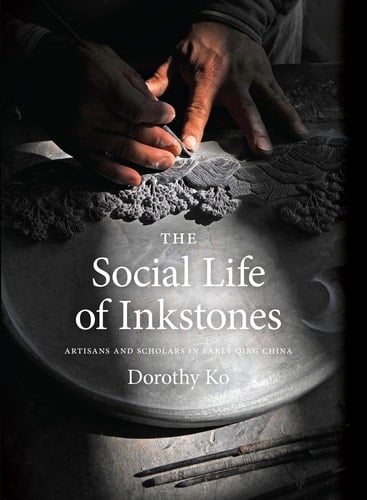
<p><b>Follows the path of an everyday object, from quarry to desk<br> <br> <br> <br></b>An inkstone, a piece of polished stone no bigger than an outstretched hand, is an instrument for grinding ink, an object of art, a token of exchange between friends or sovereign states, and a surface on which texts and images are carved. As such, the inkstone has been entangled with elite masculinity and the values of <i>wen</i> (culture, literature, civility) in China, Korea, and Japan for more than a millennium. However, for such a ubiquitous object in East Asia, it is virtually unknown in the Western world.<br> <br> <br> <br> Examining imperial workshops in the Forbidden City, the Duan quarries in Guangdong, the commercial workshops in Suzhou, and collectors' homes in Fujian, <i>The Social Life of Inkstones</i> traces inkstones between court and society and shows how collaboration between craftsmen and scholars created a new social order in which the traditional hierarchy of "head over hand" no longer predominated. Dorothy Ko also highlights the craftswoman Gu Erniang, through whose work the artistry of inkstone-making achieved unprecedented refinement between the 1680s and 1730s<br> <br> <br> <br> <i>The Social Life of Inkstones</i> explores the hidden history and cultural significance of the inkstone and puts the stonecutters and artisans on center stage.</p>
Page Count:
315
Publication Date:
2017-01-01
Community Tags
Reader Comments
No comments yet. Be the first to share your thoughts!