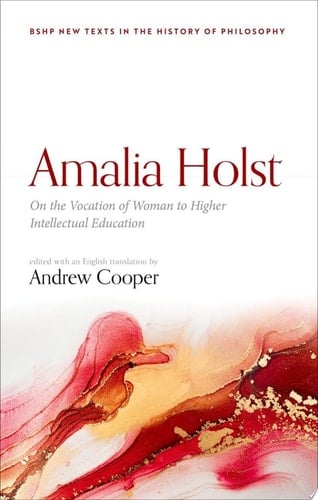
Amalia Holst: On the Vocation of Woman to Higher Intellectual Education
Part of the British Society for the History of Philosophy: New Texts in the History of Philosophy series
0
0
Author Description
This edition offers the first English translation of Amalia Holst's daring book, On the Vocation of Woman to Higher Intellectual Education (1802). In one of the first works of German philosophy published under a woman's name, Holst presents a manifesto for women's education that centres on a basic provocation: as far as the mind is concerned, women are equal partakers in the project of Enlightenment and should thus have unfettered access to the sciences in general and to philosophy in particular.Holst's manifesto resonates with the work of several women writers across Europe, including Olympe de Gouges, Mary Wollstonecraft, and Germaine de Staël. Yet in contrast to the early works of feminism we celebrate today, her book had little success. Its reception confronts us with a darker side of the German Enlightenment that, until recently, has been neglected. Holst sought to unearth the gendered nature of the fundamental concepts of the Enlightenment--including vocation, education, and culture--which enabled men to establish the subordinate status of women by philosophical means. However, her argument was scorned by male reviewers, who denied the very possibility of a woman philosopher.With an introduction by Andrew Cooper, and translations of biographical material and early reviews, this edition provides students and scholars of German philosophy with a timely resource for developing a richer understanding of their field, and general readers with a powerful early feminist text that reveals the opportunities and difficulties facing women philosophers at the turn of the nineteenth century.
Menrva's Summary
THE THESIS
Amalia Holst’s 1802 treatise investigates the fundamental question of whether women possess the intellectual capacity and moral right to participate in higher education and the broader Enlightenment project. Editor Andrew Cooper presents this first English translation to examine how Holst challenged the gendered biases inherent in the philosophical frameworks of the early nineteenth century. By analyzing Holst’s arguments alongside contemporary reviews, the text exposes the systemic exclusion of women from academic discourse and the philosophical mechanisms used to justify their subordination.
THE SCOPE MAP
What You Will Find
- A complete English translation of Amalia Holst’s 1802 work, On the Vocation of Woman to Higher Intellectual Education.
- Biographical context regarding Holst’s life and the intellectual climate of the German Enlightenment.
- Translations of historical reviews that illustrate the contemporary reception of the text.
- An introduction by Andrew Cooper contextualizing Holst within the broader European feminist tradition.
Scope Limits
- The text does not provide a comprehensive history of all women philosophers of the eighteenth century.
- It focuses specifically on the German philosophical context rather than a global survey of feminist thought.
THE AUTHORITY PERSPECTIVE
Scholars and students of philosophy identify this edition as a significant contribution to the recovery of neglected voices within the Enlightenment. Experts highlight the text as a valuable resource for understanding the specific barriers faced by women philosophers at the turn of the nineteenth century.
Page Count:
224
Publication Date:
2023-01-01
ISBN-10:
0192845942
ISBN-13:
9780192845948
Philosophy
Feminist Theory
Intellectual History
Womens Studies
Philosophy history