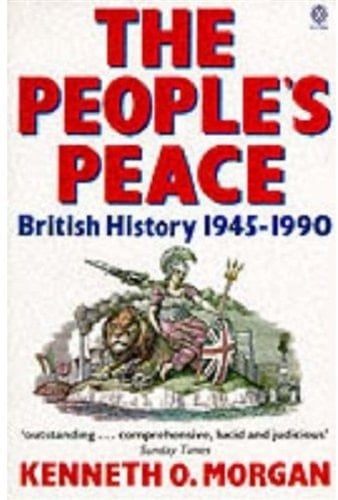
Product Description Kenneth Morgan has won wide acclaim as one of the finest historians of twentieth century Britain. His works have been hailed as "history at its very best" byNew Society--the finest combination of rigorous scholarship and lucid, enjoyable writing. Now comesThe People's Peace, the mostcomprehensive and authoritative look at post-war Britain ever written. InThe People's Peace, Morgan paints a richly detailed portrait of British social and political history from the end of the Second World War up through the rule of Margaret Thatcher. It was a time when the British, having pulled together to win what was called "the people's war," lookedforward to a people's peace--a peace of plenty and equality, provided by the Labour government's dramatic new welfare programs. But Morgan shows how the nation staggered under the debt of the war, struggling to rebuild its economy for a rapidly changing world. He examines Britain's fitful retreatfrom its imperial legacy, depicting the surprising popularity of the withdrawal from India and other colonies, and the shock of the Suez Crisis--when the U.S. made Britain's reduced role in the world painfully clear. Morgan also provides an insightful look at the changing popular culture, from theTeddy Boys to the massive adulation of the Beatles, as well as rising consumerism, permissiveness, and the ugly racism that met the tide of African, Asian, and Caribbean immigrants. From the debates over the welfare state, to the Profumo scandal, to the disillusionment with Wilson's chaotic Labour regime (leading to rumors of a military coup), to the crisis of strikes and economic decline that brought Margaret Thatcher to power, Morgan provides a lucid narrative ofBritain's post-war politics. Even after Thatcher's apparent revival of the U.K.'s vitality, he writes, it still remains a land of tremendous inequality, split between a decaying industrial north and a growing high-tech south, the Celtic fringe and English heartland, the well-paid and theunemployed--locked into decades-old patterns. "In forty-four years," he writes, "the British had yet to recover from victory in the Second World War, even though the Germans and Japanese had so manifestly recovered from defeat." Review `an outstanding work: comprehensive, lucid and judicious' Ben Pimlott, Sunday Times`Kenneth Morgan's account of the Suez crisis and Macmillan's wretched performance in it is masterly ... Often our historians have been our best prophets, and it is good to see Oxford upholding that splendid, iconoclastic tradition.' Michael Foot, Guardian`a major academic study of Britain from 1945 to the present day' Cambrian News`... a useful read for the comprehensive survey it makes of post-war Britain.' John Biffin, Church Times`Morgan's is, as one would expect, a thorough and readable narrative, mainly of the high politics of this period. No one should underestimate the sheer difficulty of putting together so lucidly such a mass of data without losing sight of the central issues. Morgan blends the narrative with analysis and comment, in my view sensibly ... He is - again refreshingly - sceptical of conventional interpretations, such as that consensus followed the war, when in fact, it was "partisanship rather than common identity [that] marked the popular mood" in the later 1940s. But he is at his best, as he has shown elsewhere, in his perceptive sketches of leading politicians, notably of Edward Heath.' Pat Thane, New Statesman and Society'Often our historians have been our best prophets, and it is good to see Oxford upholding that splendid, iconoclastic tradition.' Michael Foot, The Guardian`...anyone who studies politics will want to possess his book.' Noel Annan, The Independent on Sunday`another example of this eminent historian's ability to capture the significant elements of a debate and place them in their proper context ... a comprehensive account of the sociological and political c
Page Count:
584
Publication Date:
1992-04-23